Fixing the communication gaps that quietly drain dental clinics
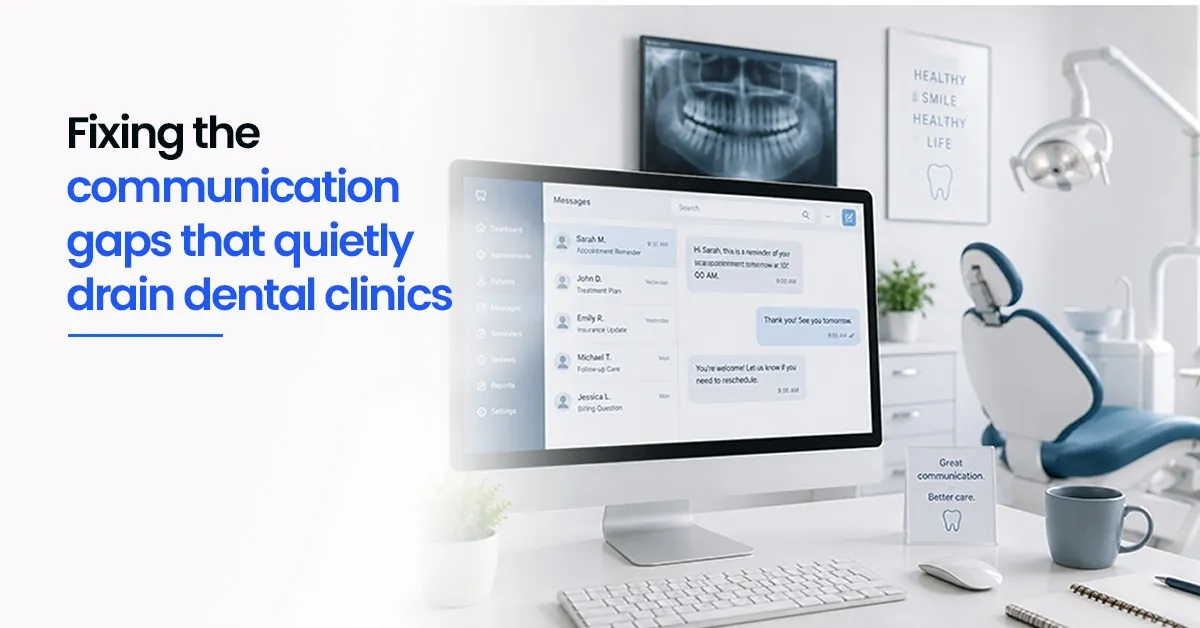

Most dental clinics lose patients not because of bad clinical care but because of what happens between appointments. A reminder that did not go out. A follow-up call that nobody made. A patient who was ready to book but waited for a nudge that never came.
These are communication gaps. They are not dramatic. They do not show up as a single large loss. They accumulate quietly — in empty chair slots, incomplete treatment plans and patients who simply do not come back.
The right software for dental clinic operations closes most of these gaps automatically. This blog covers where they happen and what fixing them actually looks like.
The real problem is inconsistency, not effort
Most dental teams are not careless about patient communication. The problem is that reminders and follow-ups depend on whoever has time that day. Some patients get a WhatsApp message. Some get a call. Some get nothing — not because staff are negligent, but because the day got busy and it slipped.
When communication depends on memory and availability, it will always be uneven. And uneven communication means an unpredictable schedule — gaps that could have been avoided with a message sent at the right time.
| The issue is not effort. It is a system that was not built to handle communication consistently at scale — whether that means 30 patients a day or 300. |
Where communication gaps cost clinics the most
These are the four points in a patient's journey where gaps most commonly occur — and what automation fixes at each one:
| Communication gap | What automation fixes |
| Appointment reminder not sent or sent too late | Automated reminder sent the day before and a few hours prior — every time |
| Post-consultation follow-up never happens | Structured follow-up message goes out 2 days after consultation automatically |
| Incomplete treatment plan — patient goes quiet | Recall message sent at the right interval to bring the patient back |
| Patient inactive for months — no contact | Soft re-engagement message goes out — no manual tracking required |
| What happens after the patient leaves the clinic is where most revenue slips. The appointment went well. The treatment was explained. But no follow-up came — so the patient stayed busy and the treatment stayed unfinished. |
Why managing communication manually breaks down
Patients communicate differently. Some prefer WhatsApp. Some reply to SMS. Some call directly. Managing all of this manually — across a busy front desk, sometimes across multiple branches — creates gaps in communication history that are hard to trace.
One staff member assumes someone else followed up. Nobody actually did. There is no record of what was sent, when, or what the patient replied. When the patient comes back months later, the team is starting from scratch.
Dental patient management software that keeps a clear communication history solves this directly. Every message, every confirmation, every follow-up — visible in one place, linked to the patient record.
How dental clinic software handles this — without removing the human element
Automation in this context does not mean replacing personal care with robotic messages. It means ensuring the right message reaches the right patient at the right time — without someone having to manually remember it every single time.
In practice: a patient books an appointment — a reminder goes out automatically the day before. A consultation is marked complete — a follow-up message goes out two days later. A patient has not visited in several months — a soft, friendly check-in goes out without anyone having to track it.
The front desk is freed from chasing every reminder manually. That time goes to the patient sitting right in front of them.
| Dental appointment reminder software is not just about reducing no-shows. It is about making sure every patient interaction has a natural next step — and that step happens consistently, not when someone remembers to do it. |
How Dentobees brings this together
Dentobees is built specifically for dental clinics dealing with exactly these gaps. Appointment reminders, post-consultation follow-ups, and recall messages are all handled through one connected dental clinic software platform — not across separate tools and spreadsheets.
Patient communication history is clear and accessible from the same place as their clinical records. For multi-branch clinics, every location follows the same process — no patient falls through the cracks because of branch-level inconsistency.
The dental app gives clinic owners and managers visibility into what communication has gone out, what is pending, and where follow-ups need attention — without having to ask the front desk.
Key takeaways
• Most no-shows and incomplete treatment plans are caused by missed communication — not patient disinterest.
• Inconsistent reminders are a systems problem, not a staffing problem.
• The period after a consultation is where most dental clinics quietly lose potential revenue.
• Dental appointment reminder software automates the communication that should always happen — but often does not.
• Dental patient management software with communication history removes confusion about who followed up with whom.
• Automation supports the front desk — it does not replace it.
Conclusion
Communication gaps in dental clinics are quiet, gradual and entirely preventable. They are not caused by poor clinical care or a disengaged team. They are caused by a system that was not built to handle patient communication consistently.
Fixing them does not require a large overhaul. It requires the right dental software one where reminders, follow-ups and patient communication history all work from the same place, automatically, without adding to anyone's workload.
That is what the right software for dental clinic operations provides. And for most clinics, the improvement shows up quickly — in fewer empty slots more completed treatment plans, and a front desk that spends less time chasing and more time caring.
Frequently asked questions
1. Why do dental patients miss appointments even when they planned to attend?
The most common reason is that no reminder reached them at the right time — or at all. For non-urgent dental visits, patients genuinely forget without a timely prompt. Most no-shows are not intentional. A well-timed reminder sent the day before and a few hours prior removes this gap for the majority of patients.
2. What patient communication can actually be automated in a dental clinic?
Appointment reminders, post-consultation follow-up messages, treatment recall reminders, and re-engagement messages for patients who have not visited in several months can all be automated. When set up correctly through dental clinic software, none of these require manual effort from the front desk — they go out automatically based on appointment status and patient history.
3. Will automation make communication feel impersonal to patients?
Not if the messages are written in a natural, friendly tone — which is entirely within the clinic's control. Patients generally appreciate timely, relevant messages. What feels impersonal is inconsistency — some patients receiving follow-ups and others not. Automation makes the experience consistent for everyone, which actually improves how patients perceive the clinic's professionalism.
4. Does dental communication software replace front desk staff?
No. It changes what front desk staff spend their time on. Repetitive tasks — manual reminder calls, tracking who was contacted, following up on unanswered messages — are handled by the system. Staff focus shifts to the patients present in the clinic, billing queries, and interactions that genuinely need a person.
5. How does a multi-branch dental clinic maintain consistent communication across locations?
By using a centralised dental clinic software platform where communication workflows are configured once and applied across all branches automatically. Each location follows the same process — reminders go out on the same schedule, follow-ups happen at the same intervals, and communication history is visible from a central view. No patient's follow-up is missed because of branch-level inconsistency.
6. How does Dentobees handle dental clinic communication gaps?
Dentobees connects appointment reminders, post-consultation follow-ups, and patient communication history in one platform. When an appointment is booked, the reminder workflow starts automatically. When a consultation is completed, follow-up messages go out on schedule. Communication history is stored alongside the patient record, so the team always knows what has been sent and what response came back — without chasing across separate tools or WhatsApp groups.
Navyatha VP is a professional content writer specializing in healthcare, dental software and digital marketing. With a background in Mass Communication and Journalism, she focuses on distilling complex topics into clear, actionable insights that help professionals make informed decisions. When she isn’t crafting digital content, Navyatha explores new social media trends, travels or loses herself in a good book.
Download our Mobile APP



Best Dental Practice Management Software & Advanced Dental ERP Suite
Door No.2328, 3rd Floor, Phase 2, Hilite Business Park, Hilite City, Kozhikode - 673014, Kerala, India
Get the latest updates from DentoBees
Click to
Subscribe