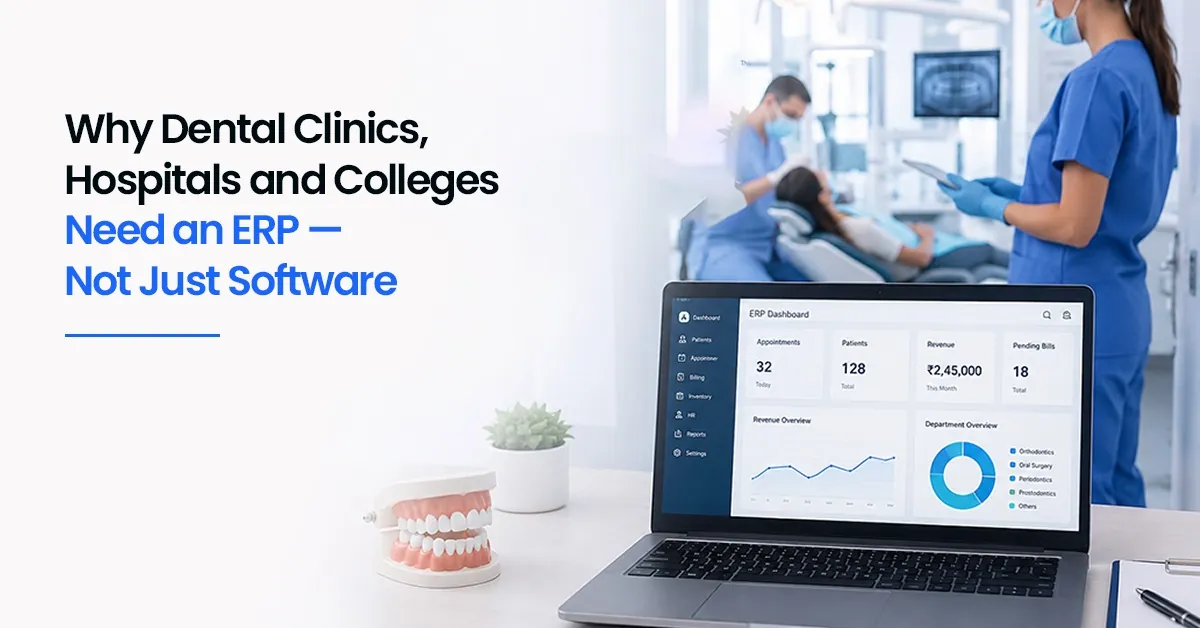
Why Dental Clinics, Hospitals and Colleges Need an ERP — Not Just Software

When was the last time you left your clinic without a single pending task in your head?
Most dentists aren't thinking about the treatment they completed at the end of a long day. They're thinking about the stock that ran low, the follow up that was missed, the bill still pending and the report due tomorrow morning.
Dental colleges and hospital departments face the same challenge more patients, more paperwork and multiple systems that refuse to talk to each other.
Here's the thing most clinics already use some form of software. There's a booking tool, a billing system, maybe a WhatsApp group holding communication together with goodwill and habit.
It looks like a system. But it doesn't work like one.
The software most clinics rely on was built to solve one task at a time not to manage an entire practice. And those small gaps between tools quietly cause missed revenue, lost patients, wasted staff time and decisions made without reliable data.
This isn't a people problem. Your team is already doing their best.
The problem is structural and it lives in the disconnected tools running your clinic every day.
The Real Difference Between Software and an ERP
Most dental setups have some version of dental clinic software already. An appointment manager here, a billing tool there and maybe a reminder system layered on top.
But running multiple disconnected tools is not the same as running a managed practice.
An ERP (Enterprise Resource Planning) is a single platform where everything connects and communicates in real time:
1.Appointments and patient records
2.Billing and payment tracking
3.Inventory and consumables
4.Staff management and attendance
5.Reports and analytics
No data gaps. No duplicate entries. No end of month reconciliation headaches.
The question isn't whether you need software. You already know you do.
The real question is whether your current setup is actually managing your clinic — or just digitising the same problems onto a screen.
Do Hospitals Already Use ERP Systems? Yes — And Here's Why
Large hospitals have been running on ERP systems for years. They use them to manage departments, track inventory across wards, handle billing at scale and maintain centralised patient records all from one platform.
Why? Because as operations grow, manual systems simply stop working.
What functions reasonably well for 10 patients a day starts breaking at 80. What works for one location becomes unmanageable across three. What one staff member can track in their head becomes a liability when the team doubles.
Dental hospitals group practices and dental colleges face exactly this complexity just in a more specific form. That's why dental practice management software built on ERP principles is no longer a luxury in dentistry. It's quickly becoming the baseline.
What Are the Actual Benefits of ERP in a Dental Setup?
In practical, day-to-day terms not theory — here's what changes when a dental setup moves to a proper ERP:
Nothing gets missed. Every treatment gets recorded. Every procedure flows into billing. Every stock item has a level that triggers an alert before it runs out.
Visibility becomes real. Instead of waiting until month end to understand how the clinic performed, that information is available any time daily, weekly, by branch and by dentist.
Staff time gets used better. When systems handle the repetitive reminders, follow-up flags, invoice generation — the front desk team can focus on patients rather than paperwork.
Multi-location stops being complicated. For practices managing more than one branch, a centralised dashboard replaces the chaos of logging into separate systems and manually putting numbers together.
Dental colleges get something extra. ERP can track student case logs, patient flow through departments and faculty workload things that basic dental software simply can't handle at that level of complexity.
Why Dentists Still Ask: "Do I Really Need This?"
It's a fair question. Many dentists especially those running smaller clinics assume ERP is something meant for large hospitals or corporate chains.
But a dental clinic is operationally more complex than it looks from the outside.
On any given day, you're managing consumables across multiple treatment types, coordinating with a dental lab, tracking patient treatment journeys that span weeks or months, managing tight appointment slots and handling billing that needs to be GST-compliant and accurate.
When the tools handling these things are disconnected and small problems compound quietly:
A missed recall reminder becomes a lost patient
An unbilled procedure becomes lost revenue
A stock shortage becomes a cancelled appointment and an embarrassed front desk
None of these are dramatic failures. They're small, invisible leaks. But in most clinics, they happen every week and they add up.
Basic Tools vs a Proper ERP — What the Difference Looks Like in Practice
| What Happens | With Disconnected Tools | With Dental ERP Software |
| Treatment completed | Billed separately, sometimes delayed | Automatically flows to billing |
| Stock running low | Noticed when it runs out | Alert triggered before it's a problem |
| Monthly revenue check | Manual consolidation from multiple sources | Real-time dashboard, always ready |
| Multi-branch visibility | Separate logins, manual reports | One centralised view |
| Patient follow-up | Depends on someone remembering | Automated reminders, tracked |
| Staff attendance | Register or separate app | Built into the same platform |
The difference isn't dramatic on any single day. Over a month or a year it's significant.
Is ERP Compulsory for Dental Clinics?
No, ERP is not legally required. No regulation mandates that a dental clinic use integrated practice management software.
But that's not really the right question to ask.
The better question is: what does running a clinic without proper systems actually cost you? In time, in revenue, in patient experience and in your own mental load at the end of the day.
Clinics that run on connected, well-integrated systems handle more patients with less friction, make fewer billing errors and respond to problems faster and scale without the operational chaos that usually comes with growth.
ERP may not be compulsory. But for any dental setup that's serious about growing it's becoming genuinely hard to operate without.
Cloud, Web or Offline — What Should You Choose?
One practical concern for many Indian dental clinics is connectivity. Not every clinic operates in a location with reliable internet — and software that stops working when the connection drops is a real operational risk.
The good news is that modern dental software options cover the full range:
Dental cloud-based software — accessible from anywhere, ideal for multi-location practices and dentists who want to check in on clinic performance remotely. Updates happen automatically no local installation needed.
Web-based dental software — runs in a browser, straightforward to set up and easy for teams to access without specialised hardware.
Offline dental software India — works without internet, syncs when connectivity is restored. Particularly practical for clinics in semi-urban or low connectivity areas across India.
The best platform doesn't force you to choose between these. It adapts to how your clinic actually operates.
A Scenario That Happens in Clinics More Often Than It Should
A dental college department runs three chairs. Students rotate through, each managing their own patient cases. At the end of the month, the department head needs to compile case logs, check which treatments were completed, reconcile billing and prepare a report for the faculty review.
With disconnected tools, this takes days pulling records from different sources, chasing down entries that were missed, correcting billing that was entered inconsistently.
With a proper ERP, every case is logged as it happens. Reports are generated in minutes. Faculty can see workload distribution in real time. Nothing needs to be reconstructed after the fact.
The clinical work is the same. The administrative reality is completely different.
How Dentobees Is Built for This
Many dental tools focus on doing one thing well appointments or billing or communication. Dentobees was built to connect all of it.
It's a complete dental practice management platform designed specifically for Indian dental workflows clinics, group practices, hospital departments and dental colleges alike.
What it covers in one platform:
1.Full patient records and treatment history
2.GST-ready billing and payment tracking
3.Real-time inventory with automatic low-stock alerts
4.Staff attendance, payroll and management
5.Multi-branch centralised dashboard
6.Daily analytics and performance reports
7.Available as cloud-based, web-based and with offline support
For a solo practitioner, it brings operational clarity without unnecessary complexity. For a growing dental chain or college it provides the infrastructure that makes scale manageable.
It's built and priced for the Indian dental market which means no enterprise-level implementation costs, no complicated rollout and no need for a dedicated IT team to keep it running.
Key Takeaways
Disconnected tools create invisible operational gaps — missed billing, stock shortages, lost follow-ups that compound quietly over time
The difference between basic dental software and a dental ERP is the difference between digitising problems and actually solving them
Hospitals have used ERP systems for years for good reason dental practices face the same operational complexity at a different scale
ERP is not legally compulsory but for any clinic serious about growing, the cost of operating without proper systems is real and ongoing
Cloud, web and offline options exist the right platform supports all three rather than forcing a choice
Frequently Asked Questions
Do hospitals have ERP systems?
Yes, most large hospitals run on ERP platforms to manage departments, billing, inventory and records from one central system. As dental practices grow in complexity especially group practices, hospital departments and dental colleges the need for the same kind of integrated infrastructure becomes equally real.
What are the benefits of ERP in healthcare and dentistry specifically?
The core benefit is connection every part of the operation working together instead of separately. In practice that means every treatment gets billed, every stock item gets tracked, every follow-up gets flagged and every report is available without manual effort. For dental setups, that translates directly into less revenue leakage and a smoother patient experience.
Why do dental clinics need ERP software — aren't basic tools enough?
Basic tools solve individual problems but don't communicate with each other. A dental clinic managing consumables, lab coordination, patient journeys and scheduling simultaneously needs systems that connect not a collection of apps each doing their own thing. The gaps between disconnected tools are where most operational problems originate.
Is ERP compulsory for a dental clinic?
No, But the operational cost of running a growing clinic without integrated systems in time, revenue and patient experience — is significant. Clinics that adopt proper systems handle more volume with fewer errors and scale without the chaos that typically accompanies growth.
What is the difference between dental software and a dental ERP?
Standard dental software handles one function appointments, or billing or reminders. A dental ERP connects all functions into one live platform where data flows automatically between them. It's not an upgrade to existing software it's a fundamentally different way of running a practice.
Navyatha VP is a professional content writer specializing in healthcare, dental software and digital marketing. With a background in Mass Communication and Journalism, she focuses on distilling complex topics into clear, actionable insights that help professionals make informed decisions. When she isn’t crafting digital content, Navyatha explores new social media trends, travels or loses herself in a good book.
Download our Mobile APP



Best Dental Practice Management Software & Advanced Dental ERP Suite
Door No.2328, 3rd Floor, Phase 2, Hilite Business Park, Hilite City, Kozhikode - 673014, Kerala, India
Get the latest updates from DentoBees
Click to
Subscribe