Scaling a dental brand: why franchise clinics need centralized dental ERP software
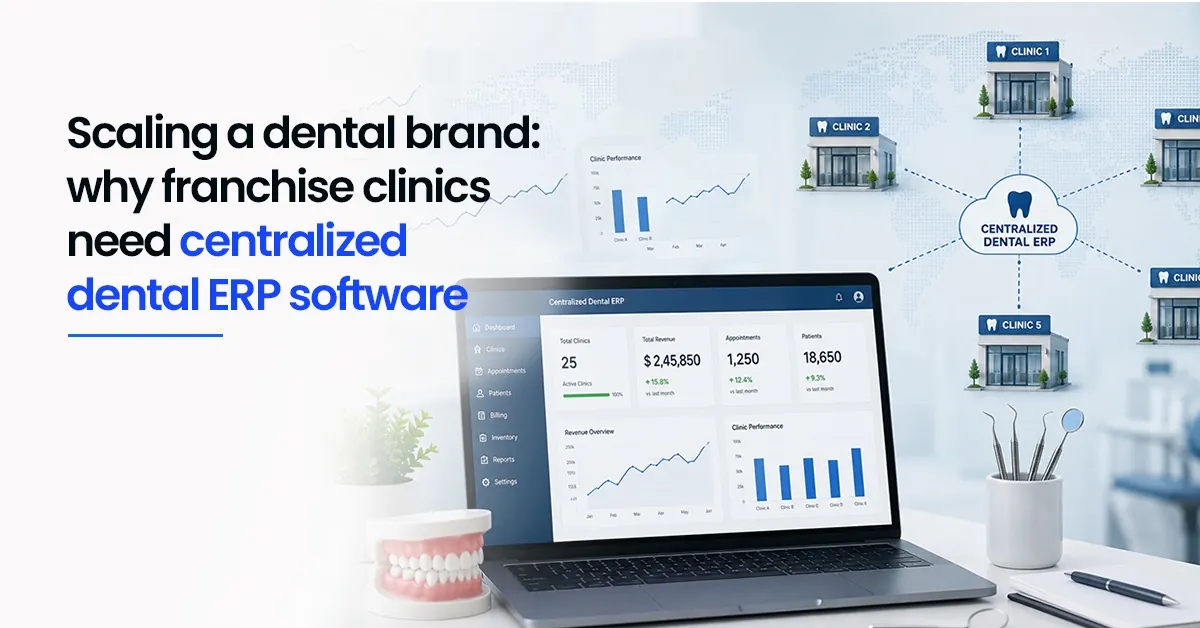

A patient visits your first clinic, gets a root canal, recovers well and a few months later moves to a nearby town where you have just opened your second branch. They walk in expecting a smooth experience same brand, same standard of care. The front desk pulls up their name and finds nothing. Treatment notes, X-rays and billing history — all sitting in a different system, in a different city.
The patient is frustrated. Your staff is apologetic. And quietly, your brand takes a real hit that no marketing campaign will undo.
This is not a hypothetical. In most multi-branch dental setups without centralized software, this kind of situation is practically guaranteed. It is not anyone's fault — it is almost always a systems problem. Each branch ends up operating like its own small business: its own records, its own billing workflow, its own way of managing stock. The brand name is shared. The operations are not.
Scaling a dental brand is genuinely exciting. A second branch means growth. A third means momentum. But without the right operational foundation — specifically, centralized dental ERP software — the cracks start showing around branch two or three. That is exactly where a dental franchise ERP earns its place.
| This blog covers the real operational challenges that emerge when dental groups scale, and how centralized ERP software solves them — across patient data, revenue, scheduling, inventory, and brand consistency. |
The real operational challenges of scaling a dental franchise
Ask any dental clinic owner managing multiple locations what keeps them up at night, and the answers tend to cluster around the same themes: communication gaps between branches, inconsistent billing, staff doing things their own way, and a general loss of visibility into what is actually happening on the ground.
Running a single clinic is already operationally demanding — appointments, patient records, billing, supplier payments and staff schedules. Multiply that by four or five branches, and without a unified system, you are essentially managing separate small businesses that happen to share a name. Each branch slowly develops its own way of doing things. Stock is managed on a spreadsheet at one location and on paper at another. Revenue reports arrive in different formats and have to be manually consolidated before anyone can see the full picture.
By the time a problem becomes visible a billing inconsistency, a stockout, a patient complaint about records — it has usually been building for weeks. The issue is not that clinic staff are not working hard. It is that no one has visibility across the whole group until something breaks.
Here is how the most common scaling challenges look with and without centralized dental ERP software:
| Challenge | Without centralized ERP | With centralized ERP |
| Patient records | Re-registration at every branch, incomplete clinical history | Full records accessible at any branch instantly |
| Revenue visibility | Manual report consolidation, data always outdated | Real-time revenue dashboard across all branches |
| Billing consistency | Fee differences between branches, errors go unnoticed | Centralised fee schedules, consistent billing enforced |
| Appointment reminders | Manual or inconsistent across branches | Automated reminders from one central system |
| Inventory | Overstocked at one branch, stockouts at another | Live group-wide stock tracking with reorder alerts |
| Staff management | Separate records at each branch, manager follow-up needed | Centralised attendance, schedules, performance metrics |
| Brand consistency | Each branch develops its own processes over time | Standardised workflows applied across all locations |
Centralized dental ERP software: the operational backbone of a growing franchise
A centralized dental practice management software does not just digitise your clinic — it connects all your locations under one operational structure. Think of it as the system through which everything in your dental group flows: patient data, revenue, appointments, inventory, and staff records. Nothing happens in isolation. Everything is visible from one place.
For dental groups managing two branches, this kind of centralization already delivers measurable value. For groups managing five or more, it stops being optional. The multi clinic dental software that serves a growing dental brand has to do more than manage appointments and generate bills — it needs to operate as a true enterprise resource planning system for the entire group.
The difference between standard software for dental clinic use and a dental franchise ERP comes down to scope. Standard dental software manages one location well. A dental ERP manages the group — connecting patient records, billing, inventory, scheduling, and analytics across every branch through one shared database, while still giving each location the tools it needs to run its day-to-day operations independently.
| One thing many dental group owners discover too late: the cost of not having centralized software grows with every branch you add. Each new location without shared systems adds more manual work, more data gaps, and more operational inconsistency. Getting the foundation right early is always simpler than untangling it after the fact. |
Unified patient data: continuity of care across every branch
Why patient records are the foundation of a scalable dental brand
When a patient can walk into any branch of your dental group and be recognized — when the dentist can pull up their full history in seconds, see their allergies, review the last procedure, check the X-rays from six months ago — the experience feels personal even at scale. That kind of continuity is what builds the patient relationships that drive referrals and long-term retention.
Without centralized dental patient management software, each branch maintains its own database. A patient who switches branches is effectively starting over. The front desk does not have their records. The dentist is treating them without a full clinical picture. Decisions get made with incomplete information — which is manageable for a routine checkup and genuinely risky for anything involving prior treatment, medications, or allergies.
Centralized patient records eliminate this gap entirely. Every branch works from the same shared database. A patient registered at Branch 1 three years ago walks into Branch 4 for the first time, and their full history is already there. No re-registration. No awkward apology about records being at the other clinic. No clinical decision made without the complete picture.
For the patient, the experience signals professionalism and trust. For the group, it is proof that the branches are genuinely one organisation — not just locations sharing a logo.
Financial control and revenue transparency across all branches
Seeing the full revenue picture — without waiting for end-of-month reports
Revenue management is where most multi-clinic owners feel most exposed. When each branch runs its own billing workflow, getting an accurate group-level financial picture requires significant manual effort — and leaves considerable room for errors to go unnoticed. Procedures that were performed but never billed. Discounts applied inconsistently. Outstanding payments that slipped through because nobody was watching the full picture.
Dental clinic billing and invoicing software built for franchise operations changes this fundamentally. Fee schedules are managed centrally and applied consistently — whether you run unified pricing across all branches or location-specific rates where market conditions justify different fees. Updates made at the group level propagate automatically, without requiring coordination between branch managers.
More importantly, real-time revenue tracking gives group owners financial visibility that a collection of branch reports simply cannot provide. Revenue by branch, by doctor, by procedure type, by period — visible at any point, not just at month end. Anomalies become detectable when they are forming. Trends become visible before they compound into problems.
| From what we have seen in multi-branch dental operations: the most common revenue leakage in franchise groups is not fraud — it is lack of visibility. Procedures undercharged, fees never updated, billing exceptions nobody noticed because no one had the group-wide picture. Centralized dental clinic billing and invoicing software closes those gaps before they become significant. |
Intelligent appointment scheduling and automated reminders
Managing appointments across multiple branches without double-bookings
Appointment scheduling sounds straightforward until you are managing dozens of dentists across multiple branches, each with different working days, chair availability, and specialisations. Without a shared calendar, each branch schedules in isolation. Floating specialists get double-booked. Patients calling to find the earliest available slot get information limited to one branch's calendar — even if another location nearby has openings tomorrow.
A centralized scheduling system gives every branch's front desk visibility into the full appointment picture across all locations. Floating dentists' schedules are visible group-wide. Patients can be booked at the best-suited branch based on actual availability, not just which branch they called. Double-bookings stop happening because the calendar is shared, not siloed.
Connected to scheduling is dental appointment reminder software that operates from the same central system. Reminders go out consistently — same timing, same format, same follow-up logic — regardless of which branch the appointment is at. No-shows reduce when reminders are reliable. And when a reminder is sent via the same dental app that manages records and billing, staff are not switching between multiple tools just to handle one patient interaction.
At the management level, a group-wide appointment view also informs staffing decisions. Which branches are consistently underbooked? Where is chair utilisation highest? Which floating specialist should spend more time at which location next month? These are questions that get answered by data rather than guesswork when scheduling is centralized.
Centralized inventory management for cost efficiency across branches
Dental consumables — gloves, impression materials, composite resins, anaesthetic cartridges, sterilization supplies — add up. In a multi-branch setup without a shared inventory system, inefficient stock management is almost inevitable. One branch over-orders and watches supplies approach expiry. Another runs out mid-week and places a costly emergency purchase. A third has surplus stock sitting in a cabinet that the second branch needed — but nobody knew because each branch only sees its own stock.
Centralized inventory management gives group managers a live view of stock levels at every branch. Low-stock alerts trigger before anything actually runs out. Surplus stock at one branch can be identified and redistributed before it expires rather than wasted. And when purchasing decisions are made with the full group picture in mind, bulk buying becomes a real cost-saving opportunity rather than an aspiration.
The connection between inventory and billing is also significant. When materials used in a procedure are linked to the billing record through the same software for dental clinic operations, actual procedure costs become measurable rather than estimated. That kind of costing accuracy is nearly impossible to achieve when inventory and billing live in separate systems — and it changes how group owners think about procedure pricing and profitability.
Standardisation across branches: the foundation of a consistent dental brand
One of the harder challenges of running a dental franchise is maintaining a consistent patient experience across every location. Not just clinical quality — the communication style, the way appointments are confirmed, the follow-up process after a procedure, the tone of the reminder message, the experience at the front desk. All of it contributes to whether patients feel they are dealing with one professional organisation or a collection of loosely affiliated clinics.
When each branch runs independently with its own systems and its own habits, standardisation is genuinely difficult to enforce. You can write policies. You can hold training sessions. But without a shared system enforcing consistent workflows, processes naturally drift as each location adapts to its own circumstances.
The only practical way to build a consistent brand experience at scale is to standardise the systems first. When every branch uses the same dental software, the processes align automatically. Appointment confirmation messages look the same. Fee schedules apply consistently. Follow-up workflows run on the same schedule. The patient experience becomes reproducible — which is the operational definition of a scalable brand.
| Dentobees is built with dental franchise groups in mind — giving every branch the tools it needs locally while ensuring the group-level standards, records, billing, and reporting all work from the same connected platform. Branch flexibility where it makes sense. Operational consistency where it matters. |
How Dentobees supports dental franchise groups at every stage of growth
Dentobees functions as a complete dental franchise ERP — connecting patient records, scheduling, dental clinic billing and invoicing software, inventory, staff management, and analytics in one platform. It is designed specifically for the Indian dental market: GST-compliant billing, multi-branch setup, and inventory management that reflects the procurement patterns common in Indian dental practice.
Patient records are stored centrally and accessible across all branches. Fee schedules can be managed at the group level and applied consistently — or configured with branch-specific pricing where the market justifies it. Dental appointment reminder software built into the scheduling module sends reminders automatically via SMS and WhatsApp, reducing no-shows without requiring manual effort from each branch's front desk.
The dental app allows clinic owners and managers to monitor performance across all branches from a mobile device — appointment volumes, revenue by location, stock levels, staff attendance — without needing to be physically present or waiting for branch managers to send reports.
For dental groups that are growing, getting the right system in place early prevents the operational debt that accumulates when branches are left to operate independently. The transition is always easier with two branches than with six. And the foundation built early — shared records, consistent billing, centralized inventory — scales with the group rather than becoming an obstacle to it.
| Ready to see how Dentobees works for a dental group like yours? Book a free demo at dentobees.com and walk through how the platform handles multi-branch operations in your specific setup. |
Key takeaways
• Multi-branch dental clinics face operational challenges that standard single-clinic software cannot solve at scale.
• Centralized dental ERP software connects patient data, billing, inventory, scheduling, and reporting across all branches through one shared system.
• Unified dental patient management software creates continuity of care — a genuine competitive advantage that builds long-term patient trust.
• Real-time revenue transparency across branches helps group owners identify problems early — not after they have already compounded.
• Dental appointment reminder software integrated with central scheduling reduces no-shows consistently across all locations.
• Standardised systems — not policies or training alone — are the practical foundation of a consistent, scalable dental brand.
• The right time to implement centralized dental franchise management software is before operational fragmentation makes it expensive to fix.
Conclusion
Building a dental brand across multiple locations is one of the most rewarding things a dentist-entrepreneur can do. It is also one of the most operationally demanding. The clinical side scales when you hire and train the right people. The business side records, billing, inventory, scheduling, reporting — scales only when the systems underneath it are built to carry the load.
Centralized dental ERP software is not a feature that makes an already-working system slightly better. For a dental franchise group, it is the operational infrastructure that makes the whole model work. Without it, each branch gradually becomes its own small business. With it, the group functions as one organisation — consistent in its standards, connected in its data, and visible to management in real time.
The dental groups that build this foundation early — even at two branches — avoid the harder, costlier work of untangling fragmented systems later, when the group is bigger and the stakes for disruption are higher.
The question worth asking at every stage of growth is not "do we need this yet?" It is "what will it cost us not to have it by the time we do?"
Frequently asked questions
1. What is dental franchise ERP software and how is it different from standard dental software?
Dental franchise ERP software is a practice management platform built to connect and standardise operations across multiple dental clinic locations — not just manage one clinic well. Standard dental software handles appointments, records, and billing for a single location. A dental franchise ERP connects all of these functions across all branches through one shared database, giving each branch what it needs locally while giving group management real-time visibility across every location. Patient records are centralized, billing is enforced consistently, and reporting covers the full group — not just individual branches.
2. When should a dental group start using centralized ERP software?
Ideally, before the second branch opens. In practice, many dental groups make the transition after experiencing the operational friction of managing two locations with separate systems — re-registration issues, billing inconsistencies, manual reporting. The transition is always easier when done proactively. Setting up centralized dental ERP software from the beginning saves significant data migration effort and operational disruption later. Even with two branches, the benefits — shared patient records, consistent billing, unified scheduling — are immediately visible.
3. How does dental appointment reminder software work in a multi-branch franchise setup?
Dental appointment reminder software integrated into a centralized ERP operates from one system across all branches — not managed separately at each location. Reminders are sent automatically based on the scheduling module via SMS and WhatsApp, with consistent timing and follow-up logic regardless of which branch the appointment is at. The admin team gets a centralized view of confirmation status across all branches, so unconfirmed slots are flagged early and staff can follow up before chairs sit empty. No-show reduction becomes consistent across the group rather than depending on each branch's manual effort.
4. How does centralized dental clinic billing and invoicing software help franchise groups?
Centralized dental clinic billing and invoicing software enforces consistent pricing across all branches — fee schedule updates apply group-wide automatically, without requiring manual coordination. It also gives group owners real-time revenue visibility: revenue by branch, by doctor, by procedure type, or by period — at any point during the month. Financial anomalies become visible when they are forming rather than after they have compounded. Common issues like unbilled procedures, inconsistent discounts, and outstanding payments are caught early because the full-group picture is always visible.
5. Is dental ERP software suitable for smaller dental groups in India?
Yes. Dental ERP software built for the Indian market — like Dentobees — is designed for groups of all sizes, not just large chains. GST-compliant billing, multi-branch setup, and inventory management reflecting Indian dental procurement patterns are standard features. Even a two or three-branch group sees meaningful operational improvement when moving to a centralized system: no more re-registration, consistent billing, shared records, and a group-level view that replaces manual report consolidation.
6. How does dental ERP software help standardise the patient experience across franchise branches?
Standardising patient experience at scale is only practically achievable through standardised systems — not through policies or training alone. When every branch uses the same dental software, appointment confirmation messages look the same, fee schedules apply consistently, follow-up workflows run on the same schedule, and the front desk process is the same regardless of location. The patient experience becomes reproducible — which is the operational definition of a scalable dental brand. Without a shared system, each branch's processes naturally drift toward whatever works best locally, eroding the consistency that makes a brand trustworthy.
7. How does Dentobees support dental franchise and multi-branch clinic management?
Dentobees is a full dental franchise ERP built specifically for Indian dental groups. It connects patient records, scheduling with integrated dental appointment reminder software, dental clinic billing and invoicing software, inventory management, staff tracking, and analytics in one platform. Patient records are centralized and accessible at any branch. Fee schedules are managed group-wide. Revenue tracking is real-time across all locations. Inventory is visible group-wide with automated reorder alerts. The dental app gives owners and managers mobile visibility into group performance without waiting for branch reports. It is designed to scale with the group — from two branches to ten — without requiring a new system at each stage of growth.
Navyatha VP is a professional content writer specializing in healthcare, dental software and digital marketing. With a background in Mass Communication and Journalism, she focuses on distilling complex topics into clear, actionable insights that help professionals make informed decisions. When she isn’t crafting digital content, Navyatha explores new social media trends, travels or loses herself in a good book.
Download our Mobile APP



Best Dental Practice Management Software & Advanced Dental ERP Suite
Door No.2328, 3rd Floor, Phase 2, Hilite Business Park, Hilite City, Kozhikode - 673014, Kerala, India
Get the latest updates from DentoBees
Click to
Subscribe