When One Clinic Becomes Three — and Everything Gets Complicated
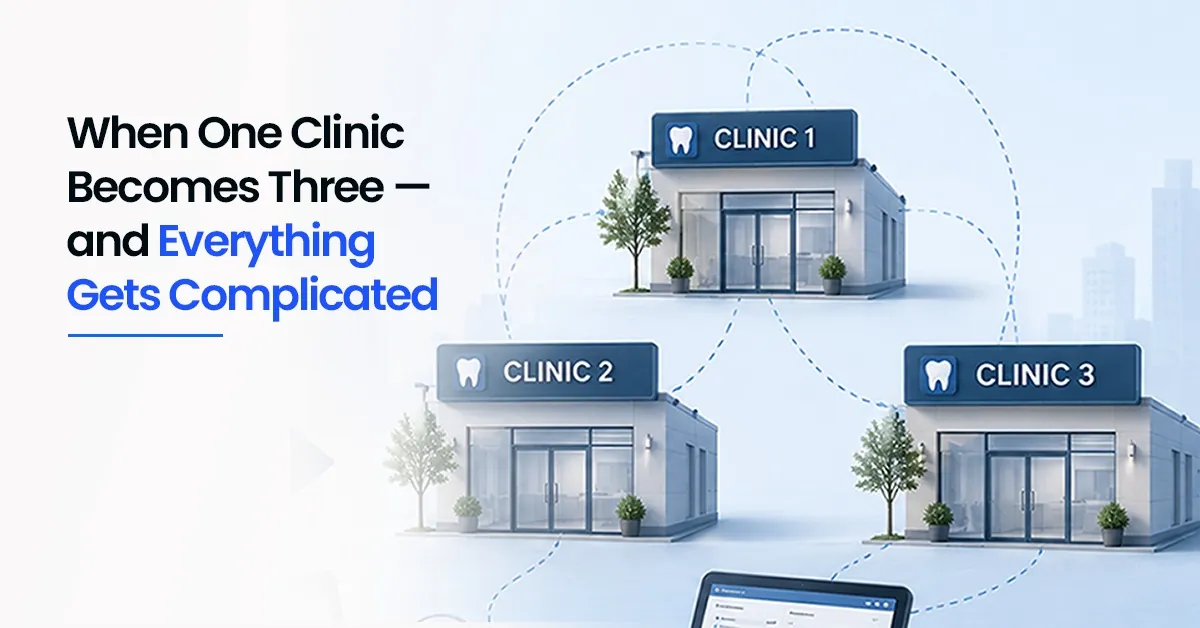

Most dentists who open a second or third clinic don't expect it to be harder than the first. They assume it's just more of the same — more patients, more revenue and more staff. Simple multiplication.
What actually happens is different.
Suddenly you're managing three different WhatsApp groups for three different branches. Your receptionist at Branch 2 is using a spreadsheet that doesn't match Branch 1's billing format. A patient who visited your Calicut clinic six months ago walks into your Kochi branch and nobody can pull up their records.
That's not a growth problem. That's a systems problem — and it's exactly what purpose-built software for dental clinics is designed to solve.
Why Most Clinics Struggle After Expansion
Here's the honest truth: most dental clinics are built to run one location well. The systems, workflows and habits that make a single clinic efficient — they don't scale automatically.
What usually happens is that each new branch develops its own way of doing things. One branch gives discounts freely and another doesn't. One tracks inventory, another eyeballs it. Reporting happens whenever someone remembers to send a message.
No one is doing anything wrong, exactly. It's just that nobody designed a dental clinic management system for multiple locations.
The owner ends up becoming the system — calling each branch, chasing updates and manually piecing together a picture of how the business is doing. That's exhausting, and it's not sustainable past two or three clinics.
The Real Cost of Fragmented Operations
Revenue leakage is one of the quieter problems in multi-clinic setups. It doesn't always look dramatic. It shows up as:
1.A treatment that was done but not billed correctly
2.A follow-up that never got sent because there was no dental appointment reminder software in place, so the patient didn't return
3.An inventory item ordered twice because two branches didn't coordinate
4.A discount applied inconsistently across locations
None of these feel catastrophic individually. Across multiple branches, over months — they add up.
Patient experience suffers too. When a patient can't get their records transferred between your own branches, or when they receive different treatment recommendations at different visits, trust erodes. In dentistry, trust is everything.
The Industry Is Moving in One Direction
The dental software market in India and globally has been growing steadily — and it's not hard to see why. According to Verified Market Research, the global dental software market is on a significant upward trajectory, driven largely by cloud adoption, operational automation and the growing need for centralized management across clinic networks.
That shift isn't just a tech trend. It reflects a real change in how serious dental groups are thinking about their operations. Platforms like CareStack have shown what enterprise-level, multi-branch dental clinic software can look like in practice — helping larger clinic networks manage data, billing and operations from a single system.
The direction is clear: clinics that want to grow sustainably are moving toward unified, centralized platforms — not more spreadsheets.
What a Centralized System Actually Changes
A good dental app or clinic management platform for multi-location practices doesn't just digitize paperwork — it creates a shared operational layer across all your branches.
Think of it this way: instead of each clinic being its own island, they all run on the same foundation. Same patient database. Same billing logic. Same workflow for follow-ups and reminders. And you, as the owner, get a single view of everything — without calling anyone.
A few things this changes immediately:
Patient continuity — Records follow the patient, not the branch. No re-explaining medical history at every visit.
Revenue visibility — You can see, in real time, what's been billed, what's pending and what looks off. Leakages become visible, which is the first step to fixing them.
Staff accountability — When workflows are standardized, it's easier to spot where things are slipping — without micromanaging.
Automated reminders — With integrated dental appointment reminder software, missed follow-ups become far less common. Patients get timely nudges, and chair time stops going to waste.
Inventory coordination — One branch ordering too much while another runs short is a common, fixable problem when there's a shared system.
How Dentobees Approaches This
Dentobees is built around the idea that a growing dental group shouldn't need five different tools stitched together. As a dedicated dental app and ERP designed specifically as dental software for India's multi-clinic market, it handles clinic operations, patient management, billing and reporting across all your branches in one place.
The practical difference is that when you log in, you're not looking at one clinic — you're looking at your whole network. You can drill into individual branch performance, compare numbers or just check that everything's running smoothly, without any branch needing to send you a report.
As multi-branch dental clinic software, it's particularly useful for catching the kind of quiet revenue loss that multi-clinic owners often discover too late — the missed follow-ups, the unbilled treatments, the inventory gaps that only show up when you look at the full picture.
One Pattern Worth Watching
In many multi-clinic setups, the branch that feels busiest isn't always the most profitable. Without proper tracking through a reliable dental clinic management system, it's easy to assume a high-traffic branch is performing well — when actually its billing efficiency or patient retention is weaker than a quieter branch.
This kind of insight only comes from data. And that data only exists when all your branches are running on the same system.
Key Takeaways
1.Expanding to multiple clinics doesn't automatically mean you've built a scalable business — systems make it scalable
2.Revenue leakage in multi-clinic setups is usually slow and invisible, not dramatic
3.Centralized management gives you visibility without requiring constant manual follow-up
4.Patient experience improves when records, workflows and communication are unified
5.Built-in dental appointment reminder software directly reduces no-shows and lost follow-up revenue
6.The dental software market in India and globally is shifting toward cloud-based, multi-location platforms — and for good reason
FAQ
Can existing clinics migrate to a centralized system without disrupting daily operations?
Most modern systems, including Dentobees, are designed for phased onboarding — so you don't have to shut down operations to switch over.
Is centralized software useful even if I only have two branches?
Yes — in fact, it's often easier to implement at two branches than at five. The earlier you standardize, the less cleanup you'll need later. Good software for dental clinics pays off from day one of expansion.
What's the biggest mistake clinic owners make when expanding?
Assuming that what worked operationally at one clinic will work at three. The systems need to evolve alongside the growth.
How does centralized billing actually reduce revenue leakage?
When billing rules, discount approvals and payment tracking are managed centrally rather than left to each branch independently, there are fewer gaps for errors or inconsistencies to slip through.
How is Dentobees different from standard dental software?
Most standard dental software in India is built for a single clinic. Dentobees is designed from the ground up for multi-branch operations — with centralized dashboards, unified patient records and network-wide reporting built in, not bolted on. It functions as a true dental clinic management system and dental app rolled into one, purpose-built for growing practices.
Navyatha VP is a professional content writer specializing in healthcare, dental software and digital marketing. With a background in Mass Communication and Journalism, she focuses on distilling complex topics into clear, actionable insights that help professionals make informed decisions. When she isn’t crafting digital content, Navyatha explores new social media trends, travels or loses herself in a good book.
Download our Mobile APP



Best Dental Practice Management Software & Advanced Dental ERP Suite
Door No.2328, 3rd Floor, Phase 2, Hilite Business Park, Hilite City, Kozhikode - 673014, Kerala, India
Get the latest updates from DentoBees
Click to
Subscribe