How Dental Franchise Management Software Helps Standardize Operations Across Branches

You open a second branch. Then a third. The growth feels good — right up until the Tuesday morning a patient walks into Branch 2, hands over their name, and gets handed a registration form. They were at Branch 1 just six weeks ago. Their records are there, not here. The front desk apologises. The patient is irritated. And somewhere in the back of your mind, you wonder whether this is how a professional multi-location practice is supposed to feel.
This scenario plays out in dental groups across India more often than anyone would like to admit. It is not a staffing problem. It is a systems problem. Each branch slowly becomes its own small operation — its own appointment book, its own billing records, its own way of doing things. And as that independence grows, so does the inconsistency.
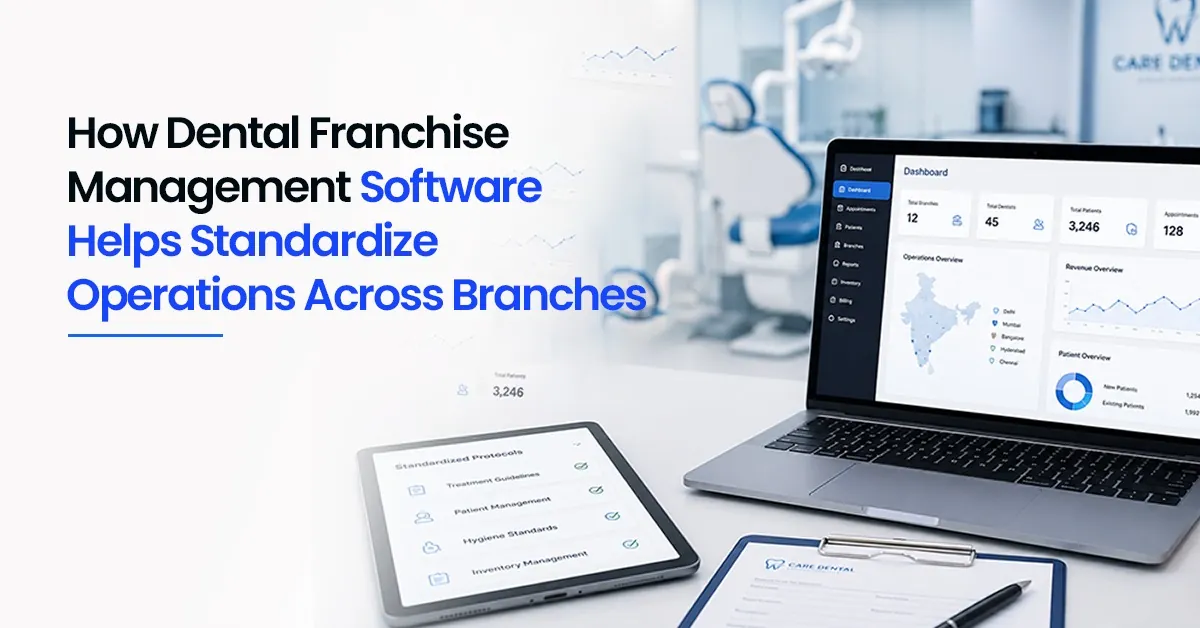
Multi-clinic dental software exists specifically to prevent this. Not by removing each branch's autonomy, but by connecting all of them through one shared system — so patients, billing, appointments, inventory, and reporting all work from the same source of truth, regardless of which branch a patient walks into.
| This blog covers how multi-clinic dental software standardises operations across dental franchise groups and multi-branch practices — and what specifically changes in patient management, scheduling, billing, inventory, and reporting when every branch works from one connected platform. |
What is multi-clinic dental software?
Multi-clinic dental software — sometimes called dental franchise management software or software for dental clinic groups — is a practice management platform built specifically for practices operating across multiple locations. Whether you call them franchise branches, group clinics, or a dental chain, the operational challenge is the same: how do you maintain consistency and visibility across locations without turning every management task into a manual consolidation exercise?
Standard single-clinic dental software is not designed for this. It handles one location well. When you try to stretch it across multiple branches, you end up with separate databases, separate reports, and staff at each location working in isolation from the others.
Multi-clinic dental software is built the other way around. It gives each branch what it needs to run its daily operations, while giving group owners and managers a single connected view of everything happening across all locations — in real time, from one dashboard.
| The distinction matters more than it might seem. A dental app or software for dental clinic that was built for one location will always feel like a workaround when stretched to multiple branches. A system built for multi-clinic use from the start handles the complexity without creating it. |
Why standardisation matters in a multi-branch dental practice
When branches run independently, inconsistency is inevitable. It usually starts with small things — a fee schedule that gets updated at one branch but not another, a policy applied differently by two front desk teams, a reminder process that one branch sends by SMS and another forgets to send at all.
Individually, none of these feel serious. But patients move between branches. They compare notes. A patient who paid one price for a root canal at Branch 1 and a different price at Branch 2 does not see a nuanced pricing policy — they see confusion. And confusion erodes the sense that they are dealing with one professional organisation.
From a management perspective, running without standardisation means always being reactive. You find out a billing error existed after it was already charged. You learn about a stockout after a procedure had to be paused. You see the revenue picture only after someone has consolidated last month's spreadsheets. By then, the moment to act has already passed.
Multi-clinic dental software changes this from reactive to proactive — consistent rules applied automatically, real-time visibility into every branch, and operational standards that do not depend on each location remembering to follow them.
What changes when every branch runs on one system
Here is a practical comparison of how multi-clinic dental software changes the most common operational pain points in dental franchise groups:
| Feature | Without franchise software | With franchise software |
| Patient records | Re-registration at every branch, incomplete histories | Patient visits any branch — full history already there |
| Appointment booking | Each branch has isolated calendar, floating staff double-booked | Live group-wide schedule, floating staff visible everywhere |
| Billing & fees | Fee inconsistencies, manual coordination between branches | Centralised fee schedule, consistent pricing applied automatically |
| Appointment reminders | Manual or inconsistent — dental appointment reminder software not linked | Automated reminders from one central system across all branches |
| Inventory | Over-ordering at one branch, stockouts at another | Live stock levels across all branches, alerts before runout |
| Reporting | Manual spreadsheet consolidation, always outdated | Real-time dashboards across all branches, no manual work |
| HR & compliance | Staff records siloed by branch, audit prep is manual | Centralised staff records, compliance reports generated automatically |
Centralised patient records: no more re-registration
In most multi-branch clinics operating on separate systems, each location maintains its own patient database. When a patient switches branches — even temporarily, for convenience — their history does not follow them. The dentist treating them sees a blank record. Allergy information, previous treatment notes, X-rays, billing history: all of it is sitting at a different branch.
This is more than a convenience problem. A dentist working without a patient's full clinical history is making decisions with incomplete information. For routine checkups, that gap is manageable. For anything involving medications, materials, or follow-up on previous work, it is a real clinical risk.
Centralised dental patient management software gives every branch access to the same shared patient database. A patient registered at Branch 1 can walk into Branch 3 six months later, and their records are already there. No re-registration. No repeated forms. No apology from the front desk about records being at the other clinic.
For the patient, this seamless experience is exactly what a multi-branch practice should deliver. For the clinic group, it is a straightforward demonstration that the branches are genuinely connected — not just branches of the same name operating independently.
| One thing worth noting: centralized records also improve compliance. When patient data is scattered across multiple local systems, data protection is harder to enforce. A single shared database with role-based access controls is easier to secure and easier to audit than information living in separate places. |
Unified scheduling and dental appointment reminders across all branches
Without a shared scheduling system, each branch manages its own appointment book in complete isolation. The front desk at Branch 1 has no idea that Branch 2 has three open slots tomorrow afternoon. A patient calling to find the nearest available time gets information limited to one branch's calendar — even if another location nearby could see them sooner.
Floating specialists are where this gets most expensive. A dentist who works across two or three branches gets double-booked because each branch only sees their own calendar. Resolving that means calls between branches, rescheduling, and an apology to a patient who planned their day around an appointment that no longer exists.
A unified scheduling system gives every branch's front desk visibility into the full appointment picture across all locations. Floating doctors' schedules are visible group-wide. Patients can be booked at the best-suited branch based on actual availability, not just habit. And double-bookings stop happening because the calendar is shared, not siloed.
Connected to scheduling is the reminder layer. Dental appointment reminder software that operates from a central system sends reminders consistently across all branches — same timing, same format, same follow-up logic. No branch falls behind because the front desk was too busy that morning to make calls.
At the management level, seeing appointment volumes across all branches in one view helps with staffing decisions. Which branches are consistently underbooked? Which are stretched? Where should a floating specialist spend more time next month? These questions get answered by data, not guesswork.
Centralised billing, consistent pricing and real-time revenue tracking
Fee inconsistencies across branches are quietly damaging. They usually start small: someone updates the root canal fee at one branch and forgets to share it, or a doctor quotes a price from memory that has not been updated in six months. But when patients notice the difference — and they do — the conversation is awkward, the explanation is unsatisfying, and the trust takes a hit that is genuinely hard to undo.
Dental clinic billing and invoicing software built for multi-branch use solves this by enforcing a single pricing source across all locations. Whether you run a unified fee schedule across all branches or location-specific rates where the market justifies it, the system applies the correct pricing consistently and automatically. No manual coordination between branches. No fee updates that reach some locations but not others.
Beyond consistency, group-level revenue tracking gives owners a financial picture that a collection of separate branch reports simply cannot provide. Instead of waiting for end-of-month summaries, you can see revenue by branch, by doctor, by procedure type, or by time period — at any point during the month. Financial patterns become visible when they are forming, not after they have already compounded.
| From what we have seen in multi-branch dental operations: the most common revenue leakage in franchise groups is not fraud or negligence — it is simply lack of visibility. Procedures that get undercharged, fees that were never updated, billing exceptions that nobody noticed because no one had the full picture. Centralised billing and invoicing software closes those gaps. |
Inventory and stock management across branches
Managing dental consumables — gloves, composites, anaesthetic cartridges, impression materials — across multiple branches without a shared system is genuinely wasteful in a very preventable way. One branch over-orders and watches supplies approach their expiry date. Another runs out mid-week and places a costly emergency purchase. A third branch has surplus stock sitting in a cabinet that the second branch needed, but nobody knew.
Centralised inventory management gives group managers live visibility into stock levels at every branch. Low-stock alerts trigger before anything actually runs out — not when a dentist asks for something and the cabinet is empty. Surplus stock at one branch can be identified and transferred rather than left to expire. And when purchasing decisions are made with the full group picture in mind, bulk buying becomes a real cost-saving opportunity.
The connection between inventory and billing is also significant. When materials used in a procedure are linked to the billing record, actual procedure costs become measurable rather than estimated. That level of costing accuracy is almost impossible to achieve when inventory and billing live in separate systems.
Real-time analytics and multi-branch reporting
Without centralised reporting, getting a clear performance picture means contacting each branch, collecting their numbers, consolidating spreadsheets, and reviewing data that was already a week old when the request was made. By the time decisions get made based on it, the situation has moved on.
Real-time analytics dashboards change this entirely. Revenue across all branches, appointment completion rates, doctor performance, patient retention by location, no-show rates by branch — all of it is visible instantly, without anyone needing to manually compile it.
This is not about micromanaging branches. It is about making decisions based on what is actually happening. Which branches are performing well and why? Where is patient retention dropping — and is it a scheduling issue, a pricing issue, or something in the patient experience? What does the revenue data say about where to focus resources next quarter? These are questions that real-time reporting answers directly, and that guesswork handles poorly.
For group owners who have been managing this through end-of-month reports and WhatsApp messages from branch managers, a live multi-branch dashboard is a genuinely different experience. The decisions get faster. The problems get caught earlier. And the sense of being in control of the whole group — not just reacting to it — changes.
| Stop waiting for end-of-month branch reports. Dentobees gives you live revenue data, appointment volumes, and patient retention metrics across all locations — updated in real time, from one dashboard. |
How Dentobees supports multi-branch dental practices
Dentobees is built with dental groups in mind. It functions as a complete dental app and multi-clinic dental software platform — connecting patient records, scheduling, billing, inventory, and analytics in one system that gives branch staff what they need locally while giving management the group-wide visibility required to actually run the practice well.
Fee schedules can be managed centrally and applied consistently across all branches — or configured with branch-specific rates where the market justifies different pricing. Revenue data across all locations is visible in real time without anyone pulling reports. Inventory levels are tracked group-wide with automated alerts. And dental appointment reminder software is built into the scheduling module so reminders go out consistently without depending on individual branch effort.
The dental clinic billing and invoicing software within Dentobees ensures that every treatment translates into an accurate invoice — across every branch — without manual re-entry or the billing gaps that come from treatment records and billing systems being disconnected.
For dental groups that are growing — whether you are opening a second branch or managing ten — the right moment to establish a shared system is earlier than most people think. The operational debt from branches that have been running independently for too long is expensive to untangle. Getting the foundation right from the start is significantly simpler.
| Ready to see how Dentobees works across multiple dental branches? Book a free demo at dentobees.com and walk through how the platform handles your group's specific setup. |
Key takeaways
• Multi-clinic dental software gives every branch shared data while giving group management real-time visibility across all locations.
• Centralised dental patient management software eliminates re-registration and incomplete records when patients move between branches.
• Unified scheduling — combined with dental appointment reminder software — reduces double-bookings, no-shows, and idle slots across the group.
• Dental clinic billing and invoicing software applied centrally prevents fee inconsistencies and makes group-level revenue tracking possible.
• Centralised inventory management eliminates over-ordering at some branches and stockouts at others.
• Real-time multi-branch analytics replaces manual reporting and makes problems visible when they are forming — not after they have compounded.
• The best time to implement a shared dental software platform is before branches become too operationally independent to align easily.
Conclusion
Expanding a dental practice is one of the most demanding things a clinic owner can do. The clinical side scales when you hire the right people. But the operational side — the billing, the records, the scheduling, the inventory, the reporting — scales only when the systems underneath it are connected.
Multi-clinic dental software is not a luxury for large dental chains. It is the operational foundation that makes a multi-branch practice function as one organisation rather than as several independent clinics sharing a name. Without it, each branch slowly drifts toward its own way of doing things. With it, the standards, records, pricing, and data stay consistent regardless of which branch a patient walks into or which branch a manager is looking at.
The practices that build that foundation early — even with just two branches — avoid the harder work of untangling fragmented systems later, when the clinic group is bigger, busier, and the cost of change is much higher.
The question worth asking at every stage of growth is simple: if a patient visits any branch tomorrow, will their experience feel like the same professional organisation? If the honest answer is "it depends," that is the gap that the right dental software closes.
Frequently asked questions
1.
What is multi-clinic dental software and how is it different from standard
dental software?
Multi-clinic
dental software is a practice management platform built specifically for dental
groups, chains, or franchise practices operating across multiple locations.
Unlike standard software for dental clinic use — which manages one location
well — multi-clinic software connects all branches through a shared database.
Patient records, scheduling, billing, inventory, and reporting all work from
one central system. Each branch handles its own daily operations, while group
management gets real-time visibility across all locations without manual
consolidation.
2.
When should a dental group start using franchise management software?
Earlier than
most groups think. Even with just two branches, the operational gaps created by
separate systems start immediately: patient records that do not follow patients
between locations, fee inconsistencies that require manual coordination,
scheduling that does not account for floating staff across branches, and
reporting that requires someone to consolidate numbers manually. Getting the
right multi-clinic dental software foundation in place at the two-branch stage
is significantly simpler than untangling fragmented systems after five or six
branches have been operating independently.
3.
How does dental appointment reminder software work in a multi-branch setup?
In a
multi-clinic dental software platform, appointment reminder software operates
from a central system rather than being managed separately at each branch.
Reminders are sent automatically based on the scheduling module — same timing,
same format, same follow-up logic — regardless of which branch the appointment
is at. This eliminates the inconsistency that comes from each branch managing
reminders manually, and ensures no-show reduction efforts are applied
consistently across all locations without depending on individual branch
effort.
4.
Can different branches have different fee schedules in dental clinic billing
software?
Yes. Dental
clinic billing and invoicing software built for multi-branch use typically
supports both group-wide unified pricing and branch-specific fee schedules.
This is useful when different locations operate in different markets or
demographic areas that justify different rates. The key difference from
managing fees manually is that the system applies the correct pricing
consistently and automatically — fee updates made centrally apply immediately
to the relevant branches without manual coordination.
5.
How does centralised dental patient management software handle data privacy?
Centralised
dental patient management software uses role-based access controls so that
staff at each branch only access records they are authorised to view. A
receptionist at Branch 1 sees the patients relevant to their work; a group
manager sees across all locations. Centralised data is often easier to keep
compliant than records scattered across multiple local systems, because
security policies, access logs, and audit trails are managed in one place
rather than coordinated across separate databases.
6.
What should a dental group look for when evaluating multi-clinic dental
software?
The key
questions to ask are: Was this dental software built for multi-branch use from
the start, or adapted from single-clinic software? How does group-level
reporting work — is it real-time or does it require manual compilation? How is
billing managed across locations — centralised fee schedules, branch-specific
pricing, or both? Are patient records genuinely shared across branches or just
loosely linked? Does the dental app or platform work on mobile for on-the-go
management? And importantly — can it scale to additional branches without
requiring a new system?
7.
How does Dentobees support dental franchise and multi-branch clinic management?
Dentobees is
built as a multi-clinic dental software platform for Indian dental groups. It
connects patient records, scheduling (with dental appointment reminder software
built in), dental clinic billing and invoicing software, inventory management,
and analytics in one system. Centralized fee schedules apply consistently
across branches. Group-wide revenue tracking is available in real time.
Inventory levels are visible across all locations with automated alerts. And
the reporting dashboard gives group owners and managers a live view of
performance across every branch — without waiting for manual reports from each
location.
Navyatha VP is a professional content writer specializing in healthcare, dental software and digital marketing. With a background in Mass Communication and Journalism, she focuses on distilling complex topics into clear, actionable insights that help professionals make informed decisions. When she isn’t crafting digital content, Navyatha explores new social media trends, travels or loses herself in a good book.
Download our Mobile APP



Best Dental Practice Management Software & Advanced Dental ERP Suite
Door No.2328, 3rd Floor, Phase 2, Hilite Business Park, Hilite City, Kozhikode - 673014, Kerala, India
Get the latest updates from DentoBees
Click to
Subscribe