From paper files to digital records: how dental clinics actually evolve
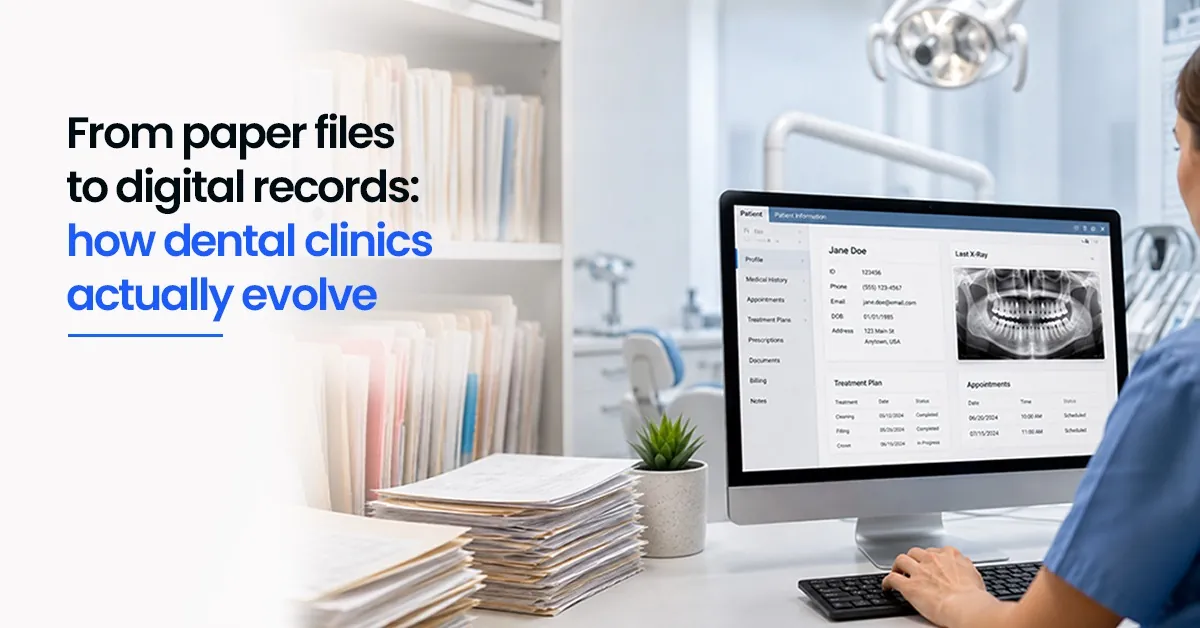

A patient walks in for their routine checkup. The front desk looks for the file. One cabinet, then another. A treatment note from the last visit is somewhere just not here. The doctor is ready. The patient is waiting. Five minutes disappear before anyone has said hello.
It does not feel like a big deal in that moment. But when it happens ten or fifteen times a day, the cumulative cost — in staff time, patient confidence and clinical continuity is real.
This is the moment most clinic owners start looking at dental clinic software seriously. Not as a technology upgrade, but as something the day-to-day genuinely needs.
The three stages most dental clinics go through
Most clinics do not move directly from paper to a fully integrated system. They go through stages — and understanding where a clinic is stuck helps identify what needs to change.
| Stage | What it looks like | Where it breaks down |
| Stage 1 Paper-based | Files, handwritten notes, manual billing | Records misplaced as volume grows; notes inconsistent between doctors; history impossible to retrieve quickly |
| Stage 2 Partial digital | Scheduling in one tool, billing in another, notes still manual | Same disconnected logic as paper — just with screens. Staff re-enter the same data in multiple places. Errors multiply. |
| Stage 3 Integrated | One platform connects records, billing, scheduling, reminders | Information entered once flows everywhere. Staff spend time on patients, not on data management. |
| Most clinics get stuck at Stage 2. They are technically digital — but still operating in fragments. Choosing software for dental clinic operations one problem at a time, without integration, just changes the type of work rather than reducing it. |
Why paper records break down as a clinic grows
Paper records are not inherently bad. For a small clinic seeing a handful of patients daily, they are manageable. The problems start when patient volume grows.
Files get misplaced more often. Notes become inconsistent — one doctor writes detailed observations, another leaves a single line. When a patient returns after six months, staff reconstruct the visit history from whatever is available.
What usually happens is that staff start relying on memory to fill the gaps. And memory, however good, is not a reliable clinical record.
One thing many clinic owners overlook: when a doctor has to ask "which tooth did we treat last time?" — even innocently — it signals to the patient that the clinic does not quite have things together. That impression is hard to undo.
The partial digital problem — why Stage 2 creates more work
Moving to basic dental software a scheduling tool, a billing module, a simple patient database — is a reasonable starting point. But what usually follows is the problem.
Appointments in one system. Billing in another. Patient notes still handwritten. Lab work tracked in a spreadsheet. Staff end up logging the same information in two or three places. Someone manually connects a billing record to a treatment note. Data does not always match. Errors creep in.
The clinic feels modern. But it still runs on the same disconnected logic as paper — just with screens in between. At this stage, software stops reducing workload and just changes where the work happens.
| The real shift is not going digital. It is moving to dental patient management software where every part of the workflow connects — so one entry updates records, billing, and follow-ups automatically, without anyone repeating the same steps across separate tools. |
What the best dental clinic software actually gets right
Everything connects — once
In an integrated dental clinic software platform, when a patient visit is recorded it links to their full history, generates the billing entry, and flags any follow-up — without staff repeating the same steps across multiple tools. Information entered once reflects everywhere.
Doctors walk into consultations already knowing the patient's history. Front desk teams spend less time searching and more time actually helping people. Billing errors that come from manual data transfer reduce significantly.
Dental appointment reminder software — built in, not bolted on
Patients forget appointments. In every clinic, everywhere. The question is how the clinic handles it. Dental appointment reminder software sends reminders automatically — typically 24 to 48 hours before a visit. Patients get a prompt to confirm or cancel. The clinic gets earlier notice when a slot is opening, and can fill it in time. Over months, this quietly improves scheduling consistency and reduces last-minute gaps.
The dental app advantage
For doctors who split time across locations, or managers who need visibility across branches, a well-designed dental app matters. The ability to check schedules, review patient records, or follow up on pending lab work without being at a desk is a meaningful operational advantage — not a convenience feature.
Dental clinic software in India: what has changed
Dental software in India has matured considerably. Solutions now exist that are built specifically for the Indian clinic context supporting multi-doctor setups, handling GST-compliant billing, and working reliably even in clinics without enterprise-level IT infrastructure.
Whether it is a single-chair setup or a multi-location group practice, the right dental clinic software scales with how the clinic operates. Clinics no longer need to choose between a system that works now and one that will work when they grow.
How Dentobees fits into this evolution
Dentobees is built around one idea: dental clinic software should simplify operations, not add another layer to manage. It brings appointments, dental patient management software, billing, lab tracking and communication into one connected workflow.
When information is entered once, it reflects across the system. No duplicate data entry. No switching between tools. No manual reconciliation at the end of the day. As a dental app, it gives doctors and managers access to what they need wherever they are.
For clinics at Stage 2 — technically digital but still fragmented — Dentobees is designed to be the integration layer that makes the whole system actually work. For clinics still on paper, it is the clean starting point that avoids Stage 2 altogether.
It works for single-location clinics and multi-branch groups without requiring a different system each time the practice expands.
Key takeaways
1.Paper records become unreliable as patient volume grows
— not because of bad staff, but because manual systems do not scale.
2.Most clinics get stuck at Stage 2: technically digital
but still operating in disconnected fragments.
3.Integrated dental clinic software connects records,
billing, scheduling, and reminders — information flows automatically rather
than being re-entered manually.
4.Dental
appointment reminder software reduces no-shows and improves schedule
predictability without adding to front desk workload.
5.A good dental app extends clinical visibility beyond
the front desk — useful for multi-location clinics and managers on the move.
6.Dental software in India is now mature enough to
support clinics of all sizes, with GST-compliant billing and multi-doctor
setups.
Conclusion
A patient returns after six months. In a paper-based setup, staff spend a few minutes finding the file and piecing together the last visit from handwritten notes. In a connected dental clinic software system, the full history is visible in seconds. The consultation starts on time. The doctor feels prepared. The patient notices.
It is a small moment — but it is what good clinic operations actually feel like. Getting there is not about adopting the most sophisticated technology. It is about choosing software for dental clinic operations that connects everything, works the way the clinic actually works, and does not require staff to compensate for its gaps.
That is the standard every clinic should be able to reach. The tools to do it exist and are accessible at any scale.
Frequently asked questions
1. What is dental clinic software used for?
Dental clinic software manages the core operations of a dental practice — scheduling appointments, maintaining patient records, handling billing, tracking lab work, and sending automated reminders. The most effective systems bring all of this into one connected platform, so information entered in one area automatically updates the others. Disconnected tools that each handle one task are technically dental software — but they create the same coordination problems as paper if they do not integrate with each other.
2. What is the difference between basic dental software and integrated dental management software?
Basic dental software handles individual tasks in isolation — scheduling, billing, or patient records as separate functions. Integrated dental management software connects all of these tasks so that when a patient visit is recorded, it automatically updates their history, links to billing, and triggers follow-up reminders. The practical difference is that staff in an integrated system enter information once rather than repeating the same data entry across multiple tools.
3. Is dental software in India suitable for smaller or single-doctor clinics?
Yes. Many solutions — including Dentobees — are designed to work effectively for single-doctor clinics as well as larger group practices. The core benefits of organised records, automated reminders, and connected billing are relevant at any size. For single-chair setups, the time saved on manual data management is often more impactful than in larger clinics because the same person is typically handling multiple roles.
4. How does dental appointment reminder software reduce no-shows?
Automated reminders sent 24–48 hours before an appointment prompt patients to either confirm or cancel. This gives clinics earlier notice when a slot is opening up, so it can be filled before it goes empty. Patients who receive timely reminders are significantly less likely to simply not show — most no-shows are caused by forgetting, not by intention. Consistent automated reminders address the root cause without adding to front desk workload.
5. Can a dental app handle complete clinic operations?
A well-designed dental app like Dentobees manages appointments, patient records, billing, and communication in one place — accessible from any device. For clinic owners and managers who move between locations, or who need visibility into branch performance without being at a desk, a mobile-accessible dental clinic software platform is a meaningful operational tool. The key distinction is whether the app is a complete connected system or just a mobile view of a limited feature set.
6. When is the right time for a dental clinic to move from paper to digital?
The practical answer is: before the problems become obvious. Paper records become difficult to manage as patient volume grows — typically when a clinic is seeing more patients than can be comfortably tracked by memory and handwritten notes. Most clinic owners who make the transition say they wished they had done it earlier. The operational disruption of switching is always lower when the clinic is not yet in crisis mode. Starting with integrated dental clinic software, rather than moving through Stage 2 first, avoids the most common transition pain.
Navyatha VP is a professional content writer specializing in healthcare, dental software and digital marketing. With a background in Mass Communication and Journalism, she focuses on distilling complex topics into clear, actionable insights that help professionals make informed decisions. When she isn’t crafting digital content, Navyatha explores new social media trends, travels or loses herself in a good book.
Download our Mobile APP



Best Dental Practice Management Software & Advanced Dental ERP Suite
Door No.2328, 3rd Floor, Phase 2, Hilite Business Park, Hilite City, Kozhikode - 673014, Kerala, India
Get the latest updates from DentoBees
Click to
Subscribe