How Messaging Integration Improves Dental Clinic Productivity
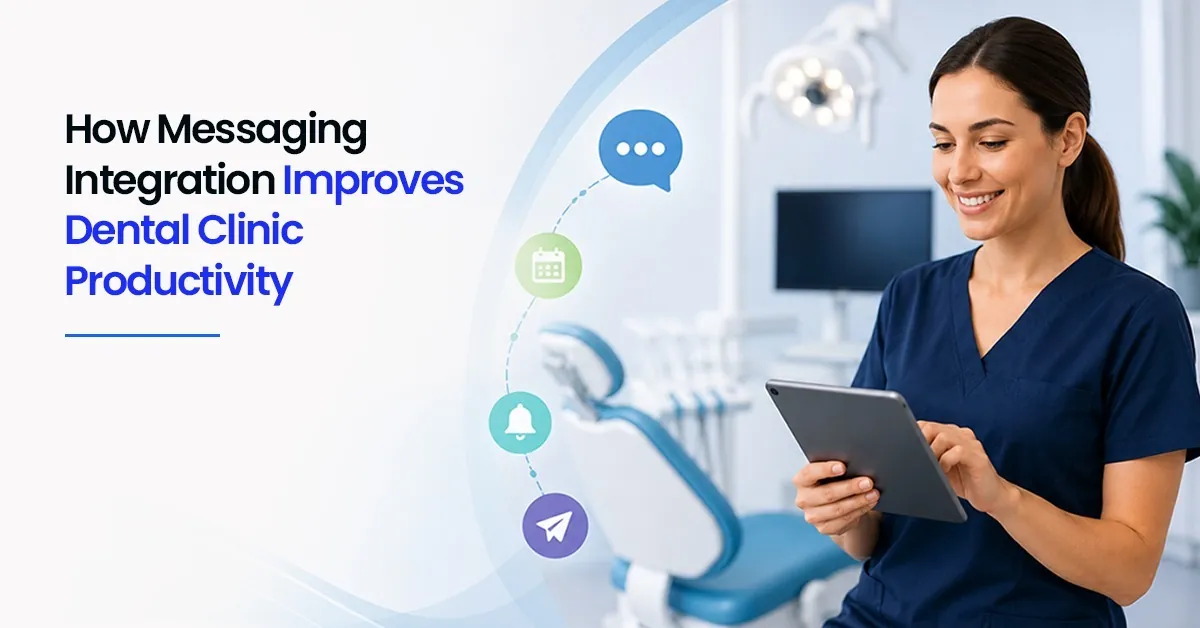

It's 11 a.m. on a Tuesday, and the front desk phone hasn't stopped ringing. A patient wants to reschedule, another is asking what time their visit is, and a third texted about a payment two days ago — nobody's checked that number since.
For a lot of Indian dental practices, that's just Tuesday. A large-scale study tracking over 1.6 million appointments found that automated reminders cut no-shows by nearly 23 per cent — proof that dental clinic communication done right pays off directly in chair time.
Dental Clinic Communication Problems That Quietly Drain Productivity
Most practices aren't short on ways to reach patients. There's the landline, a personal WhatsApp number, SMS reminders from the practice software, and maybe an Instagram DM. Each one works fine alone. The trouble starts when they don't talk to each other.
A staff member juggling four inboxes is bound to miss something. A patient who texts about rescheduling but gets no reply may simply not turn up — and the chair sits empty. None of this is anyone's fault. It's what happens when patient outreach is split across tools that were never built to connect, instead of running through one dental clinic management software platform.
This isn't just a productivity problem — research on dentist-patient interaction has repeatedly tied poor information exchange to lower treatment follow-through and weaker patient satisfaction. One peer-reviewed review on dental care quality found that breakdowns in this exchange show up later as missed visits and quiet drop-off.
Signs Your Dental Clinic Needs Better Messaging Integration
1. Reminders sent but never confirmed, so nobody knows who's actually coming in
2. Staff repeating the same answers about timing, location, or fees, across calls, texts, and walk-ins
3. A patient follow-up that slips through because there's no single record of who was contacted, and when
4. A patient bouncing between a phone call and a text, with no thread tying the two together
Why Dental Clinics Need a Connected Management System
Most clinics don't lack outreach tools — they have plenty, sometimes too many. What's usually missing is one shared thread that links a patient's calls, texts, and visit history together, the kind of view a proper dental ERP is built to provide. Without it, every team member is working off half the picture.
The ADA's own guidance on the doctor-patient relationship points to consistency as a foundation of patient trust — and that trust erodes fast when someone has to repeat themselves or chase a reply.
It's rarely about how many texts go out. It's about the lack of a shared view. When the dentist doesn't know a visit was already confirmed on WhatsApp or the desk doesn't know a payment reminder already went out by SMS, the team duplicates work — or worse, contradicts itself in front of the patient.
Why WhatsApp Matters So Much for Indian Dental Practices
Most patients in India already check WhatsApp daily, and plenty of dentists lean on WhatsApp for dental clinic communication for quick updates. The catch: on its own, WhatsApp is just another disconnected app. It only earns its keep once it's tied into the rest of the clinic's workflow.
1. Faster patient responses
2. Easy appointment confirmations
3. Better follow-ups, with nothing falling through the cracks
4. Reduced no-shows
How Connected Messaging Actually Lifts Productivity
This is the part that matters most for a busy clinic — not the tools themselves, but the time and revenue they protect.
Fewer Empty Chairs
Unconfirmed visits are the single biggest source of wasted chair time. Industry data across thousands of practices shows dental appointment reminder software alone can cut no-shows by 20 to 30 per cent within weeks of adoption — and that's before factoring in follow-up calls for the patients who still don't respond.
Less Time Spent Repeating Information
When every channel feeds into one record, staff stop answering the same three questions all day. That alone boosts front desk efficiency and frees up real time at the desk.
Faster, More Confident Follow-Ups
A connected record means anyone on staff can pick up a conversation mid-thread, without having to ask the patient to start over.
Practical Steps to Get There
1. Bring every channel into one view, so calls, WhatsApp, and texts sit side-by-side.
2. Automate the repetitive parts — confirmations, reminders, basic FAQs — and leave sensitive conversations to a person
3. Track who actually confirms a reminder, not just who received it
4. Keep one timeline per patient, instead of scattered notes across different tools
Front Desk Time Savings: Where Staff Feel It Most
Ask any front desk team where their day disappears, and the answer is rarely the patients in the chairs — it's everything happening around them.
Less manual calling, since confirmed appointments don't need a chase-up call
Faster confirmations, with replies landing in one place instead of three
Reduced daily workload, since routine questions no longer need a person to answer them
Better patient handling overall, because staff aren't piecing together context from memory
💡Pro Tip: If your front desk is checking more than two apps to respond to patients, that's usually the clearest sign messaging needs to be consolidated — not expanded.
Dentobees: Dental Patient Management Software With Built-In Messaging
Dentobees brings WhatsApp, SMS, and in-app messaging into the same dashboard as a clinic's appointments and patient records, so a confirmation sent through one channel is visible to anyone on staff, instantly — instead of a receptionist toggling between a personal phone and a separate reminder tool. For multi-branch clinics, this matters even more: a patient's communication trail stays consistent no matter which location they walk into.
Messaging Integration in Action: A Dental Clinic Example
Picture a clinic that used to send reminders by SMS and handle queries over a separate WhatsApp number. Confirmations and questions lived in two different places, and staff cross-checked both before calling anyone back. Once both moved into one connected system, the desk started working from a single thread per patient — reminder, confirmation, and any follow-up in sequence. No tab-switching, no guessing where a reply landed.
| Without Messaging Integration | With Messaging Integration |
| Reminders sent but confirmations untracked | Confirmations tracked against each appointment |
| Staff check 3-4 separate apps for patient replies | One dashboard shows every channel in one thread |
| No-shows discovered only when the patient doesn't arrive | Unconfirmed slots flagged early for follow-up calls |
| Habits vary across branches | Same patient record and process at every branch |
| The front desk repeats the same answers all day | Routine queries handled automatically, freeing staff time |
Common Mistakes Clinics Make Here
1. Adding a new channel without retiring the old one, which just creates a third place to check
2. Automating reminders but never reviewing who isn't responding, so no-shows keep slipping through
3. Letting staff use personal phones for patient WhatsApp, with no shared record once they're off shift
4. Treating outreach as a marketing function only, instead of one tied to scheduling and billing
Key Takeaways
Scattered outreach quietly costs clinics time, not just patient goodwill
The core issue is usually a lack of a shared view, not a lack of tools
Automated reminders alone can cut no-shows by roughly a fifth to a quarter
A single patient timeline cuts down repeated questions and missed follow-ups
Multi-branch practices benefit most, since consistency across locations is hardest to maintain manually
Conclusion
Better communication leads directly to better productivity — and a better patient experience follows close behind. The clinics that get this right aren't doing more work; they're doing the same work without the friction of scattered tools, missed replies, and repeated questions. That's where real, lasting productivity comes from.
Frequently Asked Questions
1. What is messaging integration in a dental clinic context?
Messaging integration means connecting a clinic's outreach channels — WhatsApp, SMS, calls, and in-app messages — into one system tied to patient records, often as part of broader dental clinic management software. Instead of checking multiple apps separately, staff see a patient's full history in one place, which makes follow-ups and confirmations faster and more accurate.
2. How does messaging integration reduce no-shows?
It lets clinics track not just whether a reminder was sent but also whether the patient actually confirmed. Good dental appointment reminder software flags unconfirmed visits early, so staff can follow up before the slot is wasted, rather than discovering a no-show only when the patient doesn't walk in.
3. Can small, single-dentist clinics benefit from this too?
Yes. Even a solo practice juggling a personal WhatsApp number and a landline can lose real time to scattered replies. Consolidating channels helps regardless of size — the time saved scales with how many patient conversations happen daily.
4. What's the difference between basic SMS reminders and full messaging integration?
SMS reminders are one-way and isolated — they don't connect to the rest of a patient's record. A proper dental patient management software platform ties every channel and conversation to the patient's appointment and billing history, so any staff member has full context, not just a reminder log.
5. Why should multi-branch dental clinics prioritise this?
Without a shared system, each branch tends to develop its own habits, making the patient experience inconsistent across locations. Centralised messaging keeps every branch working from the same patient record, regardless of which clinic the patient contacts.
Navyatha VP is a professional content writer specializing in healthcare, dental software and digital marketing. With a background in Mass Communication and Journalism, she focuses on distilling complex topics into clear, actionable insights that help professionals make informed decisions. When she isn’t crafting digital content, Navyatha explores new social media trends, travels or loses herself in a good book.
Download our Mobile APP



Best Dental Practice Management Software & Advanced Dental ERP Suite
Door No.2328, 3rd Floor, Phase 2, Hilite Business Park, Hilite City, Kozhikode - 673014, Kerala, India
Get the latest updates from DentoBees
Click to
Subscribe