How Dental Billing Software Reduces Financial Errors in Your Clinic
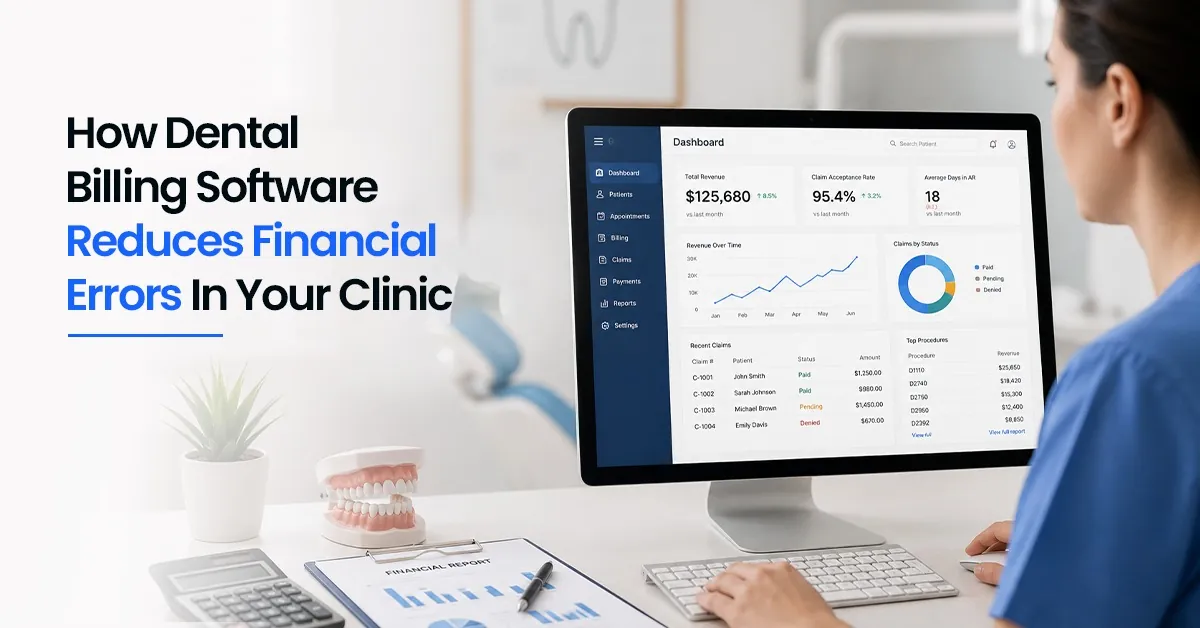

A patient comes in for a root canal, gets an extraction added mid-procedure, and by the time the invoice goes out, one treatment has quietly disappeared from the bill. The dentist moves on. The front desk assumes someone else updated the records. The clinic loses money on a procedure that was fully delivered.
Research consistently shows that 49–80% of medical bills contain at least one error — and in dental clinics, where multi-treatment appointments are the norm and billing is often handled manually, the problem is especially persistent.
Dental billing software changes the equation — not through flashy features, but through structure. Every treatment, every charge, and every payment gets a place in the system before the patient leaves the chair.
Why Billing Errors Happen in Dental Clinics
Most dental clinics in India run on a combination of handwritten registers, WhatsApp messages, and end-of-day memory. At low volumes, this holds up. As a clinic grows to 20, 30, or 40 patients a day, the gaps become costly.
Disconnected handoffs between doctor and front desk
The dentist records treatment in a notebook or passes it verbally to an assistant. By the time it reaches the billing team, something has been missed, misheard, or simply forgotten. There is no single source of truth — just a chain of assumptions.
Late documentation and end-of-day recall
When a clinic is running at full pace, updating patient records in real time is nearly impossible without a system. Most clinics catch up at the end of the day — by which point some details have already gone fuzzy. That fuzzy detail is often a chargeable procedure.
Untracked partial payments and outstanding balances
Patients who pay in instalments are especially hard to manage without a dedicated system. Follow-ups slip. Outstanding amounts get quietly absorbed as forgotten revenue. Over months, this adds up to a real, measurable loss.
🔍 Worth Knowing: Billing inaccuracies affect more than revenue — a patient who receives a wrong invoice, even if corrected, is less likely to return. Accurate billing is part of the patient experience.
How Dental Billing Software Reduces These Errors
A good dental clinic billing software does not just generate invoices faster. It changes the entire chain — from how treatment is documented to how payments are tracked and reconciled.
1. Billing starts at the treatment level
The dentist or assistant marks procedures as complete
directly in the system during the appointment. This feeds into billing
automatically. The invoice is not assembled from memory — it is built from what
was actually done.
2. Automated invoice generation removes entry errors
Pre-set treatment codes and rates are pulled directly into
the bill. There is no scope for mistyping a rate or missing a line item. What
gets treated gets billed.
3. Payment tracking without the manual chase
The system records partial payments, tracks instalment
history, and flags outstanding balances in real time. Clinic managers can see
exactly what is owed, by whom, and since when — without
opening multiple registers or Excel files.
4. Real-time discrepancy alerts
When a treatment is marked complete but no bill is raised,
the system flags it. When a payment is recorded against the wrong patient, it
shows up. These checks catch exactly what manual processes miss.
Manual vs. Software-Assisted Billing
| Scenario | Without Billing Software | With Dental Billing Software |
| Invoice creation | Manual, error-prone, assembled from memory | Auto-generated from treatment records |
| Payment collection | Easy to miss follow-ups; outstanding amounts get absorbed | Automated reminders; full instalment history visible |
| Billing discrepancies | Noticed weeks later during reconciliation | Flagged in real time at point of entry |
| End-of-month reporting | Half a day of manual checking | Done in minutes with automated reports |
How Dentobees Handles Billing Accuracy
Dentobees is built around a single idea: clinics should not lose revenue because of administrative gaps. The billing module connects treatment records, invoice generation, and payment tracking in one place — so when a dentist marks a procedure complete, the billing team sees it instantly. Invoices are generated with the correct rates already populated.
Outstanding balances, payment history, and insurance claim status are visible on the same dashboard. The dental reporting and analytics features give clinic owners a monthly picture of where revenue is being collected cleanly — and where the gaps are. That visibility alone catches problems that would otherwise surface only at year-end.
💡 Pro Tip: If you're just beginning to digitise your clinic's operations, start with billing. It delivers the fastest return — clean invoicing and payment visibility have an immediate, measurable impact on revenue collection within the first month.
A Realistic Example
A mid-sized dental clinic in Kochi was seeing around 25 patients a day across two dentists. Billing happened at the end of each day, based on whatever the treatment register captured. The typical result: two to three billing discrepancies per day — procedures missed off invoices, wrong rates applied, or patients billed for treatments they had already cleared in a previous visit.
After switching to a dental clinic management system with integrated billing, invoices were raised during the appointment itself. The front desk team stopped spending an hour each evening reconciling records. Within the first month, the clinic recovered revenue that had previously been slipping through — not because the staff had improved, but because the system made it structurally impossible for a completed treatment to leave the chair without a bill attached to it.
Common Mistakes Clinics Make With Billing
1. Treating billing as a people problem instead of a systems problem. In most cases, the team is doing exactly what they can with the tools available.
2. Running separate systems for appointments, treatment records, and invoicing. When these do not talk to each other, errors are not a risk — they are a certainty.
3. Writing off small outstanding amounts. Over months, ₹200 here and ₹500 there adds up to significant uncollected revenue across hundreds of patient visits.
4. Not reviewing billing reports regularly. Dental reporting and analytics exist to help clinic owners spot patterns — a monthly review catches chronic issues before they become structural losses.
5. Delaying adoption because "the current system works." It usually works — until the clinic grows enough to feel the cracks.
⚠️ Common Mistake: Many clinics treat billing as the final step in the patient journey. In practice, it should be woven in from the moment a treatment plan is confirmed — not assembled from memory at the end of a busy day.
Key Takeaways
Billing errors in dental clinics are almost always a systems issue, not a staff issue.
Dental billing software connects treatment documentation directly to invoice generation, removing the manual handoff where errors happen most.
Real-time discrepancy alerts, automated payment tracking, and outstanding balance visibility are the highest-impact features for reducing revenue leakage.
Starting with billing digitisation gives clinics the fastest measurable return — even before other operations are digitised.
Dental reporting and analytics help clinic owners spot gaps proactively, rather than discovering them in end-of-year losses.
Dentobees is built specifically for Indian dental clinics — handling multi-treatment appointments, instalment billing, and insurance claims in a single platform.
Conclusion
Most clinic owners know billing is a problem. They see it in the occasional patient complaint, the minor discrepancies, and the nagging sense that the month's revenue doesn't quite match the number of patients seen. That gap between what a clinic earns and what it actually collects is real — and dental billing software is the most direct way to close it.
Dentobees was built to give dental practices in India a billing system that is accurate, auditable, and practical for every team member — from the front desk raising an invoice to the clinic owner reviewing reports at the end of the week. The software doesn't just reduce errors. It makes errors structurally harder to make.
Frequently Asked Questions
1. What is dental billing software and how does it work?
Think of it as the system that sits between your treatment chair and your front desk — and makes sure nothing gets lost in between. When a procedure is marked complete, the charge is captured automatically. No manual re-entry, no end-of-day guesswork. The invoice builds itself from what was actually done.
2. How does dental clinic billing software reduce financial errors?
Most billing mistakes don't happen because someone was careless. They happen because the process relies on memory, verbal handoffs, and manual data entry — all at the end of a busy clinic day. Billing software removes those steps entirely. Rates are pre-set, treatment data flows directly into the invoice, and anything that doesn't add up gets flagged before it becomes a problem.
3. Is dental billing software suitable for small single-dentist clinics?
Absolutely — and honestly, smaller clinics often feel the impact faster. When it's just one dentist and a front desk managing 15 to 20 patients a day, there's no billing team to catch what slips through. The software handles invoicing and payment tracking automatically, so the front desk can focus on patients instead of paperwork.
4. What is the difference between dental billing software and a dental ERP system?
Dental billing software does one job — invoicing and payment collection. A dental ERP system like Dentobees does that too, but it's part of a larger picture: appointments, treatment records, patient history, inventory, analytics. Everything in one place, all talking to each other. The difference is between fixing one problem and building a system that prevents many.
5. How quickly can a dental clinic see results after switching to billing software?
Most clinics notice the difference within the first few weeks — fewer errors, outstanding amounts visible at a glance, less time spent reconciling at the end of the day. The bigger shift in revenue collection usually shows up within the first month, once the team is used to the workflow and billing is happening in real time rather than retrospectively.
6. Which dental software is best for Indian clinics?
The honest answer: the one that's built for how Indian clinics actually work. That means handling multi-treatment appointments, instalment billing, and the kind of high patient volume that makes manual processes break down. Generic software can handle basic invoicing. What Indian dental practices need is something designed around their reality — and that's exactly what Dentobees is built for.
Navyatha VP is a professional content writer specializing in healthcare, dental software and digital marketing. With a background in Mass Communication and Journalism, she focuses on distilling complex topics into clear, actionable insights that help professionals make informed decisions. When she isn’t crafting digital content, Navyatha explores new social media trends, travels or loses herself in a good book.
Download our Mobile APP



Best Dental Practice Management Software & Advanced Dental ERP Suite
Door No.2328, 3rd Floor, Phase 2, Hilite Business Park, Hilite City, Kozhikode - 673014, Kerala, India
Get the latest updates from DentoBees
Click to
Subscribe