How AI and Automation Are Improving Patient Communication in Dental Clinics
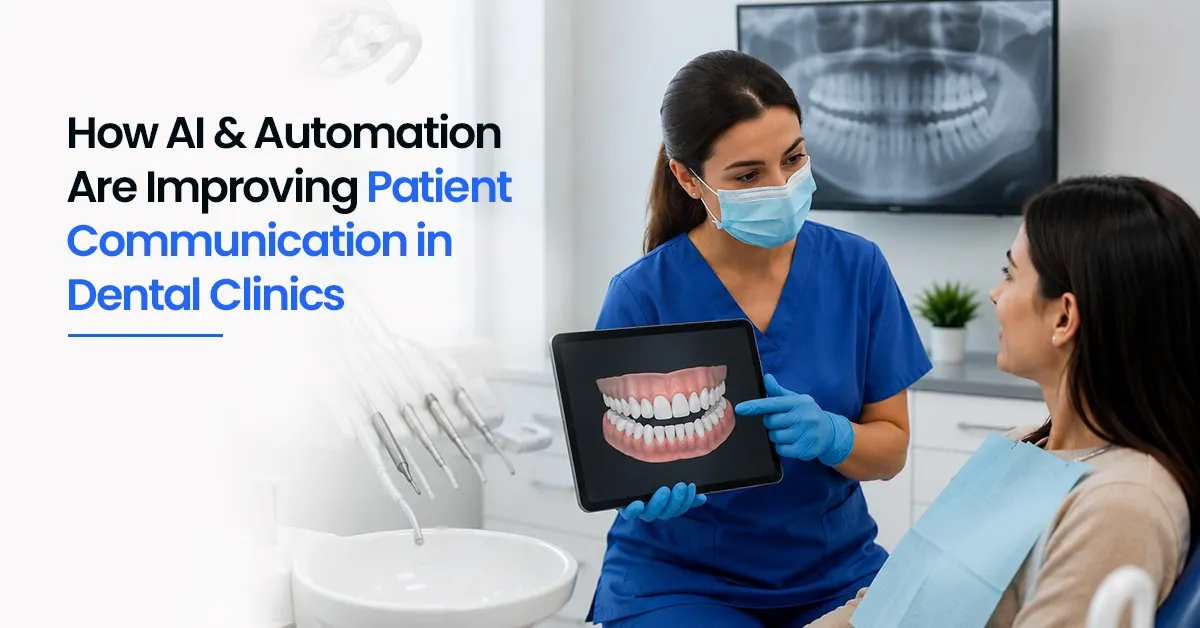

Here is a situation most dental clinics know well.
It is a Wednesday afternoon. The receptionist is on a call, confirming the next day's appointments. Two walk-in patients are waiting. Someone from billing needs a patient's payment history. And somewhere in that controlled chaos, a follow-up message for a patient who had a root canal three days ago — the one that was supposed to go out yesterday — never gets sent.
Nobody forgot on purpose. Everyone was busy with something that felt more urgent.
This is what communication failure actually looks like in most dental clinics. Not dramatic. Not negligent. Just the inevitable result of depending on manual effort for every patient interaction, every single day.
AI and automation in dental clinics do not replace the people who run your practice. What they do is take the repeatable, time-sensitive communication tasks off the team's plate — so those tasks actually happen, on schedule, every time. That is where tools like dental appointment reminder software and automated follow-up systems have become genuinely useful.
Patient Communication Is More Than Just Reminders
Most clinic owners think about communication in terms of appointment reminders — and that is a fair starting point. But in practice, communication shapes the entire patient relationship.
• A patient who receives a timely reminder actually shows up.
• A patient who gets a follow-up after a procedure feels looked after.
• A patient who receives a clear billing message knows what to do next without confusion.
Each of these moments is small on its own. Together, they decide whether a patient comes back — and whether they recommend the clinic to someone else.
What most clinics miss is this: patients rarely complain directly about poor communication. They simply stop returning. By the time the drop-off shows up in your numbers, the damage is already done.
What Usually Goes Wrong in Manual Communication
When every message is done by hand, the system depends entirely on individual staff — their bandwidth, their memory, and their priorities on any given day. In a slow clinic, that works. In a busy practice, it rarely does.
These are the failure patterns that show up most often:
• Appointment reminders go out when someone remembers — not on a fixed schedule.
• Follow-up messages get skipped during peak hours and then forgotten entirely.
• Billing reminders are delayed because no one wants to chase payments during a clinical day.
• Patients who need post-treatment check-ins fall through the gaps when the original dentist is on leave.
• There is no record of what was sent, when, and to whom — so the owner has no real visibility.
None of this is the front desk's fault. It is a systems problem. And the solution is not to work harder it is to build a system that does not depend on memory or bandwidth.
How AI Makes Dental Communication Smarter — Not Just Faster
The word "AI" gets thrown around loosely, so it is worth being specific about what it actually does inside a dental clinic context.
In good dental clinic software, AI does not generate conversations from scratch or replace human judgement. What it does is use context — appointment type, patient history, visit frequency — to make automated messages more relevant.
A patient coming in for a first consultation gets different communication than a patient returning for the third step of an implant procedure. A patient who has missed two appointments in a row might receive a more structured reminder sequence than someone with a consistent attendance record.
This context-awareness is what separates automation that feels thoughtful from automation that feels like a generic mass message. For Indian clinics handling high daily volumes, that difference matters — both for patient experience and for the actual effectiveness of the communication.
Where Automation Makes the Biggest Difference
1. Appointment Reminders That Reduce No-Shows
This is the most direct application of dental appointment reminder software — and often the most immediately useful.
Clinics schedule reminders once, and patients receive them automatically through SMS, WhatsApp, or app notifications. at the right time before their appointment. No manual calls. No missed messages on a busy day.
The reduction in no-shows is not dramatic or guaranteed — but even a modest improvement has a real effect. One empty chair, four times a week, adds up quickly over a month.
2. Post-Treatment Follow-Ups That Feel Personal
After a procedure, patients need some level of contact — care instructions, a quick check-in, or a reminder to book a review visit. This is also one of the first things skipped when the clinic is running at full capacity.
With dental patient management software, follow-ups can be configured by treatment type:
• Routine cleaning → general care reminders.
• Root canal → detailed recovery instructions and a review visit reminder.
• Extraction → aftercare tips and a check-in at 48 hours.
It feels personal to the patient — and it is also better clinical practice.
3. Billing Communication Without the Awkwardness
Chasing payments is uncomfortable. It is one of the tasks clinic staff consistently put off, which means billing messages go out late, or not at all.
Automated billing through dental clinic billing and invoicing software removes both the discomfort and the delay. Patients receive clear, timely information about their outstanding balance. The clinic follows up without anyone having to initiate an awkward conversation. Collection rates improve, and the patient experience improves too — nobody likes surprise billing calls either.
4. Recall Messages That Reactivate Lapsed Patients
Patients who have not visited in six months or a year are a quiet revenue leak in most clinics. A simple recall message — "It has been a while, time for your check-up" — is one of the most effective tools for reactivating them.
Manual recall campaigns almost never happen consistently. Automated ones do.
Manual Communication vs. Automated Dental Software
A quick side-by-side of how the same daily tasks play out with and without automation in place.
| Communication Area | With Dental Software Automation | Without Automation |
| Appointment Reminders | Sent automatically via SMS or WhatsApp — zero manual effort. | Receptionist messages individually; easy to miss on busy days. |
| Post-Treatment Follow-Ups | Triggered by treatment type — timely and consistent. | Depends on who remembers; often skipped when the clinic is full. |
| Billing Notifications | Payment reminders sent on time without manual prompting. | Staff chase patients by phone — slow and sometimes awkward. |
| Patient Record Access | All history in one place, accessible across branches. | Staff search across files and call between locations to find records. |
| No-Show Tracking | System flags repeat no-shows and adjusts reminder frequency. | No visibility — clinic only notices the empty chair. |
| Owner Reporting | All communication logged and reportable in one dashboard. | No clear picture of what went out, when, or to whom. |
The difference is not just efficiency. It is reliability. Automated dental clinic software does not have a busy day. It does not forget. And it gives the owner a clear record of everything that happened — without anyone having to pull reports manually.
Common Mistakes Clinics Make When Automating Communication
Automating everything at once
The temptation when switching to dental software is to turn on every feature simultaneously. In practice, this confuses staff and creates inconsistency during the transition. Start with the single biggest pain point — usually appointment reminders or billing — and expand once that is running well.
Choosing a system the team will not actually use
A powerful tool that the receptionist avoids because it is too complicated defeats the purpose entirely. The right dental clinic management software should be genuinely simple for daily use — not just impressive in a demo.
Sending the same message to every patient
Automation that ignores context feels impersonal fast. Patients who receive generic messages regardless of their treatment history will start ignoring them. Consistency with relevance is the goal — and good dental patient management software supports both.
Treating communication as separate from clinical care
Practices with the best patient retention treat communication as part of the care they deliver — not a separate admin function. A well-timed follow-up after a difficult procedure can carry as much weight in the patient's perception as the procedure itself.
A Typical Monday — Before and After
Before automation
The morning starts with the receptionist confirming weekend bookings. Three patients did not respond to reminders that may or may not have gone out on Friday. One patient calls to ask about a billing update that was never sent. A follow-up for a patient who had work done on Thursday is on a sticky note buried under the appointment book.
After automation
Weekend appointment reminders went out on Saturday morning automatically. The billing message for the patient with an outstanding balance was sent Friday evening. The Thursday patient's follow-up was triggered by the system based on treatment type and delivered on Saturday. The receptionist's Monday morning is spent confirming responses — not chasing them.
The clinical team is the same. The patients are the same. The difference is whether the system behind the practice is holding things together — or leaving them to chance.
How Dentobees Supports Patient Communication
Dentobees brings appointment reminders, follow-up messages, billing notifications, and patient record management into a single connected system. For clinics managing multiple locations, everything runs from the same platform — so a patient who visits a different branch still receives consistent communication.
The goal is not to add complexity. It is to reduce the daily coordination burden on the front desk while making sure the communication that matters actually goes out. It works as a dental app for daily operations and as a broader dental ERP platform for clinics that need multi-branch oversight, inventory visibility, and centralised reporting.
Key Takeaways
• Communication gaps in dental clinics are almost always a systems problem, not a people problem.
• Dental appointment reminder software reduces no-shows by making reminders consistent — not by working harder.
• Post-treatment follow-ups configured by treatment type feel more personal and are clinically better practice.
• Automated billing notifications improve collection rates without any manual chasing.
• The right dental software should be simple enough that the team actually uses it every day.
• Knowing what was sent, to whom, and when is as valuable as the automation itself.
Final Thoughts
Most communication problems in dental clinics are not caused by bad people. They are caused by good people running into the limits of what manual work can hold up under. The clinics that solve this are not the ones with more staff — they are the ones with a system that handles the predictable parts on its own.
AI and automation are not about replacing the human side of patient care. They are about protecting it — by clearing the small repetitive tasks off your team's desk, so the time spent with patients is the time that actually matters. For a clinic looking to grow without growing the chaos, that is where the real shift happens.
Frequently Asked Questions
1. How does AI improve patient communication in dental clinics?
AI uses context — appointment type, treatment history, visit frequency — to send relevant, timely messages rather than generic reminders. In dental software, this means appointment reminders, follow-ups, and billing notifications go out automatically and appropriately, without depending on any individual staff member's availability on a given day.
2. Why is dental appointment reminder software worth investing in?
Missed appointments are a predictable, preventable revenue loss. Dental appointment reminder software sends reminders automatically through SMS, WhatsApp, or app notifications without the front desk having to manually contact each patient. Even a small improvement in attendance translates to real revenue over a month — and the staff time saved can be redirected to patient care.
3. Can dental software handle billing communication automatically?
Yes. Dental clinic billing and invoicing software can send payment reminders and billing updates on a set schedule — clearly, on time, and without manual prompting. This removes the discomfort of staff chasing patients for payments and ensures patients receive the right information before it becomes a problem. Every interaction is logged automatically.
4. Is Dentobees suitable for both small and growing clinics?
Yes. Dentobees is built for single-location clinics as well as multi-branch practices. Core features — appointment reminders, follow-ups, billing automation, and patient records — apply from day one. Multi-branch features like centralised reporting and shared patient history become more relevant as the practice grows.
5. What is the practical benefit of a dental app for patient communication?
A dental app brings all patient communication — reminders, follow-ups, billing updates — into one trackable system. Staff can see what was sent and when, without searching across message threads or spreadsheets. For patients, the experience feels organised and consistent. For the clinic, it means fewer gaps, better retention, and less time spent on communication that should have gone out automatically.
Navyatha VP is a professional content writer specializing in healthcare, dental software and digital marketing. With a background in Mass Communication and Journalism, she focuses on distilling complex topics into clear, actionable insights that help professionals make informed decisions. When she isn’t crafting digital content, Navyatha explores new social media trends, travels or loses herself in a good book.
Download our Mobile APP



Best Dental Practice Management Software & Advanced Dental ERP Suite
Door No.2328, 3rd Floor, Phase 2, Hilite Business Park, Hilite City, Kozhikode - 673014, Kerala, India
Get the latest updates from DentoBees
Click to
Subscribe